How To Test MDMA
How to Test MDMA for Purity and Safety (2026 guide)
Testing molly or ecstasy? Start here
Substances sold as MDMA are frequently something else. Test for fentanyl first, then find out what the sample actually is.
MDMA, molly and ecstasy all name the same chemical, 3,4-methylenedioxymethamphetamine, a stimulant and empathogen in the amphetamine family. It reaches people as pressed pills, loose powder or crystal, and the form on its own tells you nothing about what's inside. What gets sold under those names is often something else: MDA, methamphetamine or amphetamine, a cathinone, a substituted phenethylamine such as 2C-B, PMA or PMMA, DXM, or a mixture, and the powder can be bulked out with caffeine, sugar or inert filler. Fentanyl and nitazenes have turned up in samples sold as molly, which is why an opioid screen comes before everything else.
The tests on this page work in tiers, and each one stops at a different place. Fentanyl and nitazene strips are immunoassays that screen for a single target class and tell you only whether that opioid sits in the portion you dissolved, nothing about the rest of the sample. Marquis, Simon's, Mecke and Mandelin are reagent color tests: they narrow a sample toward or away from a chemical family by the color and speed of the reaction, and read together they build a strong presumptive case, yet no reagent names the exact molecule on its own. The QTest quantifies roughly how much MDMA is present once spot kits have established that it's MDMA, and it measures that one compound only. Only laboratory analysis confirms which molecule you're holding, so read this page for what the tests rule out in the piece you check, not for permission to dose.
Common MDMA terminology
New to this? These are the words the rest of the page uses. Tap any term to expand it.
MDMA (molly, ecstasy)
Three names for one chemical, 3,4-methylenedioxymethamphetamine, a stimulant and empathogen in the amphetamine family. It's sold as pressed pills, powder or crystal, and the form on its own tells you nothing about purity or identity.
MDA
A close chemical relative frequently sold as MDMA, with different effects and a longer duration. Marquis and Mecke can't separate the two; Simon's narrows it, and only lab analysis confirms MDA specifically.
Cut / adulterant
Anything added to or substituted for the drug, from inert bulking agents like caffeine and sugar to active substances such as methamphetamine or a cathinone. A reagent flags many adulterants, but a minor one can hide behind the stronger reaction of whatever is most abundant.
Presumptive
A result that points toward or away from a substance without proving it. Reagent and strip results are presumptive: they support a conclusion but never settle it the way a laboratory does.
Reagent (spot) test
A drop-on color test, such as Marquis or Simon's, that narrows a sample toward a chemical family by its color and timing. It screens and narrows; it doesn't name the exact compound present.
Simon's reagent
A two-part reagent that detects secondary amines, turning bright blue for MDMA. A muddy grey-green or no reaction points away from MDMA, but a blank result matches many other substances, so Simon's can't identify MDA on its own.
Fentanyl test strip
An immunoassay strip that screens for fentanyl and many of its analogs in the portion you dissolve. It doesn't detect nitazenes or every novel opioid, and a negative describes only the spot you tested.
QTest
A quantitative kit that estimates how many milligrams of MDMA are present. It measures one compound and assumes you've already established the sample is MDMA; it identifies nothing and screens for no adulterant.
PMA / PMMA
Paramethoxyamphetamines sometimes sold as MDMA and lethal at amounts close to an ordinary MDMA dose. Mandelin ends reddish-brown rather than bluish-black with them, while Mecke is unreliable for this and shouldn't be leaned on.
Which test do I need?
Essential first test. Read at five minutes. No reagent can do this.
Shop FentKitSimon's narrows it down. Bright blue versus muddy grey-green or nothing.
Shop Simon'sMandelin separates paramethoxyamphetamines from MDMA. Mecke does not.
Shop MandelinSeparation kits test each component individually and estimate proportions.
Shop Gemini
The MDMA testing flow chart. The sections below walk this same path in order, and the combination table further down shows how to read all three reagents together.
Test for fentanyl first
Fentanyl has been found in samples sold as molly. Our FentKit screens for fentanyl and a broad range of its analogs. Dissolve roughly 10 mg in about half a teaspoon of water, dip the strip, and read at five minutes.
That makes even a small amount of an opioid contaminant extremely dangerous. Keep naloxone on hand, never use alone, and don't rely on a friend who is also rolling to notice a problem.
- They don't detect nitazenes. These potent synthetic opioids need separate nitazene strips.
- They don't detect every fentanyl analog. Some analogs and novel opioids read negative.
- A negative result only describes the portion you tested. Fentanyl is often unevenly distributed. Test more than one spot from a larger batch.
- Dilution matters. Too little water can push a sample toward a false positive; too much can produce a false negative. Follow the ratio in the instructions rather than guessing.
What color should MDMA turn?
Marquis is the primary test. Simon's and Mecke narrow it down further. Every reaction below is from our official reaction library, filmed on verified MDMA. Read yours against the printed booklet in bright, neutral daylight, and use a fresh sample of the drug for each reagent.
The package trio: Marquis, Simon's, Mecke

Arrives almost immediately, and MDA looks identical here. A slow, smoking grey-black over 15–30 seconds is DXM; see the timing note below.
Watch full reaction
Bright blue means a secondary amine. Paired with a purple-black Marquis, it's the strongest home indication of MDMA, though still presumptive. Muddy grey-green or nothing points away from MDMA; see the MDA note below.
Watch full reaction
A cross-reference only: MDA gives a very similar dark result, so Mecke can't separate the two. Don't rely on it for PMA either; that's Mandelin's job.
Watch full reactionGoing deeper: the full reaction library

The PMA screen: MDMA ends bluish-black, PMA/PMMA end reddish-brown. Mandelin is naturally mustard yellow, so run a blank drop alongside.
Watch full reaction


Reacts strongly to primary amines, a helpful check against amphetamine and MDA-type substitutions.
Watch full reaction
No reaction is normal; a color here points to something other than MDMA.
Watch full reaction
Purple would mean an indole such as LSD or a tryptamine, never MDMA.
Watch full reaction- Marquis turns orange to brown means amphetamine or methamphetamine, not MDMA.
- Marquis turns yellow means a cathinone ("bath salt") is dominant.
- Marquis darkens slowly (15–30 s) and smokes is DXM. Timing is the tell; see below.
- Simon's is muddy grey-green or gives nothing is not the clear bright blue of MDMA. MDA is one possibility; see the note below.
- Mandelin ends reddish-brown flags possible PMA/PMMA, lethal near ordinary MDMA doses. Do not consume.
- Any bright yellow-green surprise suggests a substituted phenethylamine such as 2C-B or 2C-I, active at single-digit milligrams.
Marquis reagent color guide, the primary reference for MDMA. Also available as the printed booklet in every Marquis Spot Test Kit, or as a web page at the Marquis reaction booklet.
Simon's used to be described as giving no reaction with MDA. Since 2021, MDA frequently gives a muddy grey-green to blackish Simon's reaction instead. DanceSafe tracked this, sent the samples for lab analysis, and confirmed them as MDA. Both outcomes are now expected.
That has two consequences. First, a muddy dark reaction can be misread as MDMA's blue. If the color is dull, grey-tinged or greenish rather than a clear bright blue, don't read it as MDMA. Second, and more importantly, a Simon's non-reaction does not identify MDA. It only tells you there is no secondary amine in the sample. Amphetamine, 2C-B, 2C-I, mescaline, DXM, 5-APB, 6-APB and most cathinones all give nothing on Simon's too.
Confirming MDA specifically needs lab analysis; our mail-in lab, Transparency Testing, can do it. MDA is active at lower amounts than MDMA, is more stimulating and more neurotoxic, and lasts longer.
Simon's reagent color guide. Bright blue for MDMA; muddy grey-green or nothing for MDA. Printed booklet included with the Simon's Spot Test Kit.
Dextromethorphan's Marquis endpoint is grey to black, visually very close to MDMA's purple-black, especially under warm indoor light. The difference is how fast it gets there. MDMA goes purple-black almost immediately. DXM starts with little or no change, often smokes, and takes roughly 15–30 seconds to darken.
Watch the drop from the moment the reagent lands and note the elapsed time. A slow, smoking darkening is a red flag.
DXM is a tertiary amine, so it gives zero on Simon's as well. A DXM sample therefore looks like "dark Marquis, nothing on Simon's," the very pattern people have historically been told means MDA. It does not.
- Scrape or crush a few crumbs, a pinhead's worth or roughly a few milligrams, onto a clean white ceramic plate.
- Add one drop of reagent from above. Never touch the bottle tip to the sample; that contaminates the whole bottle.
- Watch from the instant the drop lands. Note the color and how quickly it appears.
- Read within 40 seconds. After that the reaction continues to change and is no longer meaningful.
- Use a fresh sample of the drug for each reagent. Do not drop a second reagent onto a spot you have already tested.
- Place one fresh sample on the plate.
- Add one drop of Simon's A on top of it.
- Add one drop of Simon's B on top of the same sample.
- Read within 40 seconds.
Do not put A on one sample and B on another; that's the most common Simon's error and it produces nothing useful. Sample + A + B, in that order, on one spot.
- They cannot detect fentanyl. Fentanyl is active in microgram amounts and produces no reagent color at realistic adulterant concentrations. Only test strips can screen for it.
- They show what's most abundant. A dark reaction from MDMA will overshadow a lighter reaction from a minor adulterant, hiding it completely.
- They say nothing about how much is present. A 250 mg pill and a 90 mg pill of the same purity look identical.
- They can't name an analog. MDA, MDEA, MDAI, 5-APB, 6-APB and 5-MAPB all react in overlapping ways. Confirming which one you have needs lab analysis through Transparency Testing.
- Pill dye interferes. Strongly colored tablets can tint or mask a reaction. Scrape from the interior of the tablet, not the coated surface.
Reading your three results together
Use the combination, not any single reagent.
| Marquis | Simon's | Mecke | What this pattern is consistent with | What to do |
|---|---|---|---|---|
| Purple-black, immediate | Bright blue | Blue-green to dark blue-black | MDMA | The expected MDMA pattern, still presumptive. Test for fentanyl regardless; color says nothing about strength |
| Purple-black, immediate | Muddy grey-green to blackish | Very dark blue | MDA, most likely, but not confirmed | A different drug with different effects and a longer duration. Confirm with lab analysis before deciding |
| Purple-black, immediate | No reaction | Very dark blue | Ambiguous. MDA is one possibility; so are several other compounds | Do not read this as MDA. Send it for lab analysis |
| Grey to black, slow, 15–30 seconds, smoking | No reaction | Variable | DXM | Do not consume as MDMA or MDA. High-dose DXM is a dissociative with serious interaction risks, including with SSRIs and MAOIs |
| Orange to brown | Blue (methamphetamine) or nothing (amphetamine) | Little or nothing | An amphetamine-type stimulant, not MDMA | Do not consume as MDMA. Testing methamphetamine |
| Yellow | Varies by compound | Varies by compound | A cathinone ("bath salt") is dominant | Do not consume. Cathinone dosing and duration are unpredictable |
| Yellow to green, or any bright unexpected hue | No reaction | Bright yellow through to dark black-yellow | A substituted phenethylamine such as 2C-B or 2C-I. Reagents cannot tell these apart | These are active at single-digit milligram doses. Lab analysis, or discard |
| Purple-black, immediate | Bright blue | Reddish brown on Mandelin | Possible paramethoxyamphetamine (PMA, PMMA, PMEA) in the mix | Do not consume. PMA is lethal at amounts close to a normal MDMA dose and comes on slowly, which leads people to redose |
| Nothing, or a faint pale color | No reaction | Nothing | No MDMA in the portion tested, or too little sample, or expired reagent | Re-run with a larger sample and fresh reagent before drawing any conclusion |
Mecke reagent color guide: use it as a cross-reference, not as a second opinion on MDMA versus MDA. Printed booklet included with the Mecke Spot Test Kit.
Cross-reference with more reagents
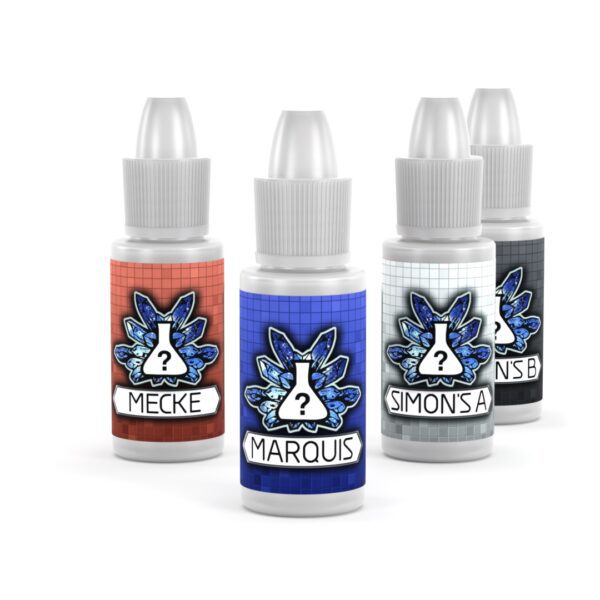
The MDMA Spot Kit Package costs less than buying the three kits separately.
- Marquis reagent
- The primary test. Purple to purple-black, almost immediately, for MDMA and MDA. Orange to brown flags amphetamines; yellow flags cathinones.
- Mecke reagent
- Blue-green deepening to dark blue or black for MDMA. Broad cross-reference for opioids, cathinones and phenethylamines.
- Simon's reagent (two bottles, A and B)
- Bright blue for MDMA. Muddy grey-green or no reaction for MDA. Both drops go on the same sample.
Fentanyl strips are sold separately because no reagent in this package can detect fentanyl.
Substances commonly sold as MDMA
| Substance | Category | How to screen for it |
|---|---|---|
| Fentanyl | Synthetic opioid | Fentanyl test strips only; no reagent detects it |
| Nitazenes | Synthetic opioid | Nitazene strips; fentanyl strips do not detect these |
| MDA | Close analog, active at lower amounts, longer duration | Simon's narrows it down (muddy grey-green or no reaction, with a purple-black Marquis). Marquis and Mecke cannot separate MDA from MDMA. Confirmation needs lab analysis |
| Methamphetamine | Stimulant | Marquis (orange to brown) |
| Amphetamine | Stimulant | Marquis (orange to brown), no reaction on Simon's |
| Methylone, MDPV, butylone, pentylone, eutylone | Cathinones ("bath salts") | Marquis (yellow), though it varies by compound and some give little or nothing |
| PMA, PMMA, PMEA | Paramethoxyamphetamines, lethal near normal MDMA doses | Mandelin (reddish brown). Mecke is unreliable here and should not be relied on |
| 2C-B, 2C-I, 2C-E, 2C-T-7 | Substituted phenethylamines, active at a few milligrams | Reagents give wide, overlapping ranges and cannot identify which. Treat any unexpected yellow or green as a red flag; confirm by lab |
| DXM | Dissociative cough suppressant | Marquis timing: slow grey-to-black over 15–30 seconds, often smoking. Zero on Simon's |
| MDAI, 5-APB, 6-APB, 5-MAPB | Research chemicals with MDMA-like reactions | Reagents overlap heavily. Lab analysis |
| Caffeine, sugar, inert fillers | Bulking agents | Purity test: shows up as a reduced percentage |
Testing purity
The MDMA QTest Kit estimates MDMA concentration in powder, crystal or pressed tablets, so you can work out roughly how many milligrams are in a pill or what percentage a crystal is.
A QTest estimates how much MDMA is present. It does not identify what makes up the rest. A sample can read 88% MDMA and the remaining 12% can still contain methamphetamine, a cathinone, or a fatal amount of fentanyl. Run strips and spot kits first.
The kit reacts similarly with MDA, 6-APB and 5-MAPB but is not accurate for those substances, so a reading only means something once spot kits have established that you're most likely dealing with MDMA. It does not work on liquids. Full instructions are on the QTest basics page.

Step by step
- Test for fentanyl. Roughly 10 mg in half a teaspoon of water, read at five minutes. Test more than one spot from a larger amount.
- Run Marquis. A pinhead of crushed sample, one drop, watch from the instant it lands. Purple-black within about five seconds is consistent with MDMA or MDA. Slow grey-black over 15–30 seconds points to DXM.
- Run Simon's on a fresh sample. One drop A, then one drop B on the same spot. Bright blue is consistent with MDMA. Muddy grey-green, or nothing, is not.
- Run Mecke on a fresh sample. Blue-green to dark blue-black is expected. Anything brightly or differently colored is a red flag.
- Add Mandelin if PMA is a concern in your area. Reddish brown rather than bluish black means stop.
- Read the pattern, not one color. Use the combination table above.
- Test purity, optionally. Only once nothing unexpected has turned up.
- Record it. Photograph your results in good light next to the booklet, and send unresolved samples to Transparency Testing for a definitive answer.
- Reading a color without timing it. For MDMA versus DXM, the clock is the test.
- Putting Simon's A on one sample and Simon's B on another. Both go on the same spot.
- Dropping a second reagent onto a spot you've already tested. Use a fresh sample every time.
- Dim or colored lighting. Bright neutral daylight is best; a muddy grey-green and a dark blue look alike under a colored bulb.
- Testing the colored coating of a pill instead of its interior. Tablet dye tints or masks reactions.
- Too much or too little sample. A pinhead, roughly a few milligrams.
- Old reagent. Store cool and dark, ideally a fridge or freezer, and replace it when Marquis or Mecke has darkened enough to obscure the reaction.
- Reading only one reagent. They show what's most abundant; a minor adulterant can be masked entirely.
Your result wasn't what you expected
- Find out what it actually is. Mail a sample to Transparency Testing, our mail-in lab analysis service. It gives a definitive answer where reagents can't, including MDMA versus MDA and which analog you're holding.
- If an opioid is plausible, have naloxone. Keep it on hand and never use alone. Nitazenes may need more than one dose of naloxone.
- Rule out the test itself. Re-run with fresh reagent, a properly crushed sample, correct drop order and better lighting before drawing conclusions.
After you test: recovery support
MDMA depletes serotonin and taxes the body even when the sample is exactly what it should be. Our Roll Kit recovery supplements are designed to support your body during a roll and smooth out the comedown afterward, a companion to testing rather than a substitute for it.
Questions
How do I tell MDMA from MDA?
Simon's narrows it down: bright blue is consistent with MDMA, while MDA gives either a muddy grey-green to blackish reaction or nothing at all. Marquis and Mecke cannot separate them; both give purple-black and dark blue respectively for either compound. Because a Simon's non-reaction also occurs with a long list of other substances, confirming MDA specifically requires lab analysis through Transparency Testing.
Can reagents detect fentanyl in my molly?
No. Fentanyl is active in microgram amounts and produces no color change at the concentrations found in adulterated samples. Screening for it needs fentanyl test strips, and those don't cover nitazenes.
Can I test pressed pills?
Yes. Scrape a few crumbs from the inside of the tablet with a knife point rather than testing the colored outer surface, and use a fresh scraping for each reagent. Bear in mind that a pill's color, stamp and shape tell you nothing reliable about its contents.
My Marquis went dark but slowly. What does that mean?
Time it. MDMA and MDA go purple-black almost immediately. A grey-to-black color that takes 15–30 seconds and smokes is characteristic of DXM. Don't treat the two as the same result.
How much sample do I need?
Reagent tests need about a pinhead, a few milligrams. Fentanyl strips need roughly 10 mg dissolved in half a teaspoon of water. The QTest needs a measured amount, so follow the kit instructions.
Does a good set of results mean my MDMA is safe?
No. Reagent tests are presumptive, they don't detect everything, they can't see a minor adulterant behind a strong reaction, and they describe only the piece you tested. Testing lowers your risk of an unpleasant surprise; it doesn't remove risk.
How long do the kits last?
Each spot kit is good for 50–100 tests. Store reagents cool, dark and upright, ideally a fridge or freezer, and let them come back to room temperature before use.
Test before you roll
Marquis, Mecke and Simon's in one package. Orders ship within 24 hours.
50–100 tests per kit · Free shipping over $75 · Discreet packaging
More resources
- Our types of test kits
- How to test for fentanyl
- How to test for nitazenes: why fentanyl strips aren't enough
- QTest purity kit basics
- Skylab separation kit basics
- Marquis color guide · Mecke color guide · Simon's color guide · Mandelin color guide
- MDMA reaction video library: every reaction above, in full, plus substance info
- Spectrum color guide
- DanceSafe: important reagent reaction updates: the source for the MDA and 2C-B changes above
- Lab testing with Transparency Testing: for the questions reagents can't answer
A sample that has been tested should not be considered safe. There is inherent risk when choosing to consume any substance.
Many factors are involved when conducting a test and examining reactions, and The Bunk Police does not assume responsibility for the interpretation of results. Reactions of individual samples can vary depending on lighting differences and the specific mixtures of substances being tested.
Bunk Police kits are intended for identifying unknown substances for harm reduction purposes only. The Bunk Police does not assume responsibility for the use or misuse of this information. Proceed at your own risk.