How To Test LSD
How to Test LSD for Authenticity and Safety (2026 guide)
Testing a tab? Start here
What's sold as acid is sometimes an NBOMe, a DOx compound, a different lysergamide, or nothing at all. Reagents can tell you a tab is unexpected. They can't tell you it's fine.
Acid is the street name for LSD, which belongs to a chemical family called lysergamides. It's sold on paper tabs, in gelatin squares, as liquid in a vial, and pressed into pellets. What's sold as acid is often something else — an NBOMe, a DOx compound, a different lysergamide, or a blank piece of paper.
A reagent is a liquid that changes color when it touches certain compounds. You put a drop on a small piece of your sample and watch what happens over the next few minutes, then compare that color against reactions we've filmed on lab-confirmed LSD. A matching color tells you a lysergamide is present. It doesn't tell you which one, and only a laboratory can.
Common LSD terminology
New to this? These are the words the rest of the page uses. Tap any term to expand it.
Blotter (tabs)
Squares of paper soaked in an LSD solution and dried. It's the most common form and the one holding the least material, at roughly 500 to 1500 micrograms of everything on the square combined, which is why reactions run faint.
Gel tab
Small gelatin squares that hold more per volume than blotter, with the active concentrated in the center of the square, so where you cut matters.
Liquid LSD
Dosed in drops from a vial. Concentration varies from vial to vial and drifts as solvent evaporates, and none of that is visible from the outside.
Lysergamide / indole
Lysergamides are the chemical family LSD and its analogs belong to, and the indole ring inside them is what the Ehrlich reagent detects. Psilocybin and DMT are indoles too, so a purple result places a sample in the family without naming which member it is.
Prodrug / analog
Compounds such as 1cP-LSD, 1V-LSD and 1D-LSD that convert to LSD in the body. Most blotter on the market now carries one of these rather than LSD itself.
NBOMe and DOx
The dangerous substitutes sold as acid: NBOMes (25I, 25C, 25B) and DOx compounds (DOM, DOB, DOC). They fit on blotter, look identical, and can harm at doses that overlap what people take as a tab.
Microgram (µg)
The unit LSD is measured in. A tab typically holds tens to low hundreds of micrograms of active material.
Reagent (spot) test
A drop-on color test that's presumptive: it narrows a sample toward or away from a family and never confirms a specific substance on its own. Only laboratory analysis confirms which molecule is present.
Which test do I need?
Ehrlich alone. Purple within about 5 minutes, longer for prodrugs.
Shop EhrlichBoth reagents. Hofmann's deep blue separates lysergamides from psilocybin and DMT.
Shop the packageQTest for at-home purity testing. Blotter, liquid and sugar cubes only — no gel, no analogs.
Shop QTestNo home kit can name a lysergamide; instrumental analysis can.
Transparency Testing lab
The LSD testing flow chart. The sections below walk this same path in order.
What color should LSD blotter turn?
Ehrlich is the primary test for a lysergamide on blotter. Hofmann is the follow-up that separates lysergamides from other indoles. Neither one names the specific molecule, and neither one clears a tab. Both reactions below are from our official reaction library, filmed on verified LSD blotter, and the same lab-verified videos are free to match against in the Transparency app.

The primary test. Purple means an indole is present: every lysergamide gives this, and so do psilocybin, DMT and 5-HTP. Give it up to 5 minutes.
Watch full reaction
May pass through yellow before settling deep blue, which is the canonical lysergamide result. Don't discard a tab for going blue instead of purple.
Watch full reactionMatch your result against the printed booklet in bright neutral daylight, not against a monitor; on-screen hues are for orientation only. Every LSD reaction video is also in our LSD showcase on Vimeo.
Ehrlich reagent color guide, with dozens of reference reactions. Also included as the printed booklet in the Ehrlich Spot Test Kit and the LSD Spot Kit Package.
Hofmann reagent color guide. Hofmann is the reagent that separates lysergamides from other indoles: lysergamides go deep blue, other indoles go yellow to green.
- Cut roughly a tenth of a tab; a small corner is enough.
- Put the sample piece in a test tube. Add 1–2 drops of Ehrlich.
- Watch for up to 5 minutes; purple is consistent with a lysergamide.
- Repeat on a fresh piece with Hofmann. Deep blue, sometimes purple-tinged, is consistent with a lysergamide.
- If nothing has happened and a prodrug is plausible, keep watching. Prodrugs hydrolyze into LSD in the reagent — color can arrive after 5–10 minutes, sometimes an hour or more.
Never run two different reagents on the same piece of sample.
- They cannot tell lysergamides apart. Ehrlich detects the indole ring, and every lysergamide is an indole. LSD, 1P-LSD, 1cP-LSD, 1V-LSD, 1D-LSD, ALD-52, AL-LAD, ETH-LAD and LSZ all give the same purple. The difference matters: ETH-LAD in particular is meaningfully more potent by weight than LSD, and "it went purple" tells you nothing about which one you're holding.
- Ehrlich does not react to NBOMes, because they're phenethylamines rather than indoles, so it stays quiet. Hofmann reacts yellow-orange to them. To rule them out, follow up with Marquis, Mecke, or Liebermann; see the NBOMe note below.
- A non-reaction is never a pass. No color means either there's no indole present, or there's too little material, or your reagent has degraded. All three look identical.
- Blotter carries very little active material: roughly 500 to 1500 micrograms of everything, active and inactive combined. Faint, slow and partial reactions are the norm, not a sign of something wrong.
NBOMes (25I-NBOMe, 25C-NBOMe, 25B-NBOMe and others) are sold as acid because they're cheap, they fit on blotter, and they look identical. They can cause seizures, cardiovascular collapse and death at doses that overlap with what people take as a tab. DOx compounds (DOM, DOB, DOC) carry similar substitution risk.
After Ehrlich and Hofmann, run a follow-up with Marquis, Mecke, or Liebermann; any of these can rule out NBOMes and DOx in the piece you test. What you're looking for is an instant, vivid color change: Marquis goes bright yellow-green with an NBOMe, and Hofmann reads yellow-orange rather than blue. A slow browning or gradual color shift is not an NBOMe reaction; that's the paper and the acid.
Two reassuring notes: research suggests a sample that does contain LSD is extremely unlikely to carry another adulterant alongside it, and a purple Ehrlich plus deep blue Hofmann is the opposite of the NBOMe pattern. If reagent results don't point to LSD, run one of the three follow-ups, and for certainty send it to Transparency Testing for lab analysis.
- Colored gel and printed blotter. Dye leaches out of blue, purple and heavily printed media straight into the reagent. It can mimic the color you're hoping for, or drown out the one that's actually there. Use an undyed corner where you can, and always run the blank control described above.
- Sugar reacts with Hofmann on its own. A sugar cube gives a color change with no LSD in it whatsoever.
- Sugar cubes, mints, gummies and chocolates are unsuitable for reagent testing. The medium interferes and the active is distributed unevenly through it. If that's the form you have, the answer is lab analysis, or the LSD QTest for sugar cubes specifically.
Cross-reference with more reagents
LSD barely reacts with most other reagents, which is exactly what makes them useful. A strong, fast color from any of these means something other than LSD is present. All reactions from the official library, on verified LSD blotter.

Slow yellow-browning is normal, and partly the acid on the paper. An instant, vivid yellow-green flags an NBOMe — do not consume.
Watch full reaction
Compare against the booklet; colors on blotter run faint.
Watch full reaction
Warm tones expected; anything vivid and instant is a red flag.
Watch full reaction
Blue would flag a secondary amine like meth or MDMA.
Watch full reaction
A strong color means something else is present.
Watch full reaction
Same rule: quiet is normal, loud is a warning.
Watch full reaction
Reacts with primary amines, which helps spot amphetamine-type substitutions.
Watch full reaction- Hofmann turns yellow-green and stays there: a non-lysergamide indole such as psilocybin or DMT, not LSD.
- Simon's turns blue: a secondary amine like meth or MDMA.
- Any vivid, instant color on Marquis, Mecke or Liebermann: likely an NBOMe or DOx compound. Do not consume; see the NBOMe note above.
- Hofmann turns yellow-orange: the NBOMe pattern, not a lysergamide.
- No reaction to anything is unresolved, not negative: a blank tab, a slow prodrug, too little material and dead reagent all look identical.
The LSD Spot Kit Package costs less than buying the two reagents separately and lets you run the Ehrlich and Hofmann checks side by side.
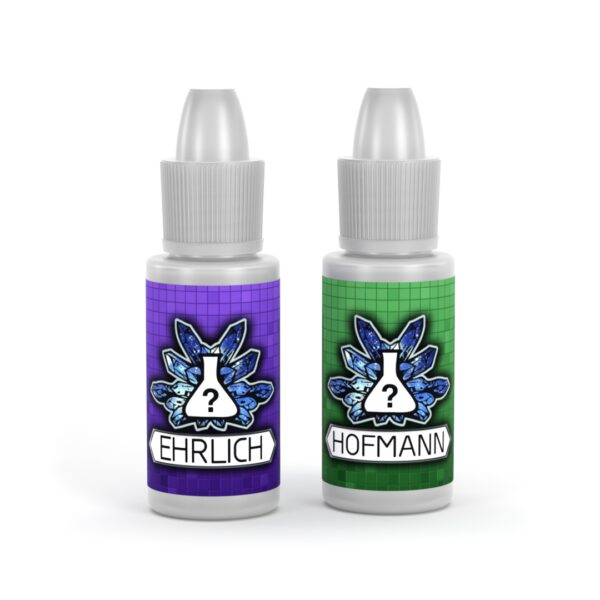
- Ehrlich reagent — 1 bottle, 50–100 uses
- The primary test for a lysergamide. Purple is consistent with an indole; it does not name the molecule.
- Hofmann reagent — 1 bottle, 50–100 uses
- Separates lysergamides (deep blue) from other indoles (yellow to green). Reacts with sugar, so not for sugar-based media.
- 2 test tubes
- One per reagent. Don't share a sample between reagents.
- 2 instructional booklets, 20+ pages each
- Dozens of printed reference reactions — the color source to compare against.
- 2 durable plastic jars
- They double as stash jars.
Running a second reagent is worth doing not because it confirms the first, but because it can surface something the first one missed.
For the most detail available short of a laboratory, our Skylab Separation Kits separate a mixture into its components and give a rough sense of how much of each is present. The Juno Separation Package includes Ehrlich and Hofmann; the Curiosity (Pro Level) Separation Package includes every reagent we carry.
Gel tabs, liquid, microdots, and prodrug analogs
Gel tabs
Gel tabs are gelatin squares that can hold more per volume than blotter and hold potency longer. Two things matter before you start: the LSD is typically concentrated in the center of the tab, so cut the tab down the middle and test a small piece from the center, not a corner. And Hofmann is the more reliable reagent on gel, because gelatin can muddy Ehrlich into an unreadable result; weight the deep blue Hofmann reaction and treat Ehrlich's purple-pink as supporting evidence, not confirmation. Gel reacts slowly, so allow up to 30 minutes and read streaking in the expected colors as a reaction.
- Put a piece of the gel tab — from the center — in a very small amount of water, a few drops.
- Add one drop of dilute sodium hydroxide solution to break the gelatin down. One drop. Excess base neutralises both Ehrlich and Hofmann, and you'll get a flat non-reaction from a perfectly real tab.
- For a cleaner result, add ethyl acetate to the mixture, separate off the solvent layer, drop it onto a ceramic testing platform, and let it evaporate fully without heat.
- Test the residue (or the dissolved liquid, if you skipped the solvent step) as you would blotter — the reactions should now match typical LSD reactions.
Sodium hydroxide is caustic: it burns skin and permanently damages eyes. Wear eye protection, work over a surface you don't mind ruining, keep it off your hands, don't inhale over the container, and rinse any splash with plenty of running water. Never add water to concentrated base: add base to water. Full precautions on our safety information page. If you don't want to handle it, skip the extraction and just test the gel directly with a long observation window.
Liquid LSD
Liquid LSD usually carries around 100 µg per drop, but it can carry far more: LSD settles in the vial, so one drop can hold several times what another does, and solvent evaporates over time, concentrating what's left. None of that is visible from the outside. For testing, dry it first: put a drop on plain white untreated paper, let it dry fully, then test the dried paper. Test a piece of the same paper untreated first, so you know the paper isn't reacting on its own. Here's how liquid drops read in the library:


Microdots
Microdots, the tiny pressed pellets sold as LSD, react differently from blotter because the binder dominates the tablet. Most reagents show nothing at all; Ehrlich and Hofmann shift clear-to-red rather than the purple and blue you'd see on paper. Compare against these, not the blotter set:


Prodrug analogs
Most blotter on the market now carries a prodrug rather than LSD itself: 1cP-LSD, 1V-LSD and 1D-LSD in particular, along with 1P-LSD and ALD-52. They convert to LSD in the body, and they do something useful in the test tube too: left sitting in the reagent, they hydrolyze into LSD and eventually react. Expect no reaction in the first minute, then the familiar pink-purple Ehrlich and soft purple-blue Hofmann developing after 5–10 minutes, sometimes an hour or more. One partial tiebreaker: 1P-LSD gives a soft reddish-purple with Marquis, while 1cP-LSD gives no Marquis reaction. That hint aside, no reagent names which lysergamide you have; that takes lab analysis. More in our analog testing guide.
What gets sold as LSD instead
| What it might be | How far you can get at home |
|---|---|
| NBOMes (25I, 25C, 25B and others) | No Ehrlich reaction; Hofmann yellow-orange; instant, vivid bright yellow-green with Marquis. A follow-up with Marquis, Mecke or Liebermann rules these out for the piece tested; look for the instant vivid change, not slow browning |
| DOx compounds (DOM, DOB, DOC) | No Ehrlich reaction; instant vivid colors on the Marquis/Mecke/Liebermann follow-up. Active at a few milligrams, so a substitution here is a dosing hazard |
| Lysergamide analogs (1P-LSD, 1cP-LSD, 1V-LSD, 1D-LSD, ALD-52, AL-LAD, ETH-LAD, LSZ) | Same purple and blue as LSD, arriving late as the analog hydrolyzes. Marquis offers one hint: soft reddish-purple suggests 1P-LSD, no reaction suggests 1cP-LSD. Naming which one still takes lab analysis |
| A blank tab with nothing on it | Looks exactly like a failed test. This is the main reason a non-reaction is unresolved rather than negative |
| Fentanyl or nitazenes | Implausible on blotter — a square can't hold a meaningful dose. Reagent colors will not show either one |
| Blotter dye and ink | Run a blank control. Dye is a source of both false positives and masked reactions |
Testing potency (micrograms)
The LSD QTest Kit is a single-use quantitative test that estimates how many micrograms of LSD-25 are present in blotter, liquid or sugar cube form. Instructions are on the QTest basics page.
The QTest measures concentration. It does not identify your substance and it does not screen for adulterants. Run spot kits first.
Two hard limits: it does not work on gel tabs, and it does not react to 1P-LSD, 1cP-LSD, ALD-52 or ETH-LAD. Since prodrug blotter is now common, a low or zero QTest reading on a real, active tab is an expected outcome rather than evidence of a fake. For a gel tab's microgram content, Transparency Testing's Complete Analysis can measure it.
Step by step
- Run a blank. Plain paper, or an unprinted corner of the same sheet, with one drop of reagent. Establish that the medium isn't reacting.
- Run Ehrlich on about a tenth of a tab. Give it 5 minutes; give a suspected prodrug an hour.
- Run Hofmann on a fresh piece. Deep blue, sometimes purple-tinged, is consistent with a lysergamide.
- Interpret conservatively. Purple then deep blue is the expected pattern; no reaction is unresolved, not negative.
- Optional QTest for micrograms, only after the spot kits.
- Record it. Photograph your results in good light next to the booklet, and send unresolved samples to Transparency Testing for a definitive answer.
- Reading too early. There is no one-minute answer here: Ehrlich commonly takes up to 5 minutes, gel up to 30, prodrugs an hour or more.
- Colored gel or heavily printed blotter with no blank control.
- Sugar cubes, mints, gummies and chocolate; the medium reacts or interferes.
- Too little sample. A tenth of a tab is the minimum worth trying; a speck won't do it.
- Dim or colored lighting. Bright neutral daylight, and compare against the printed booklet.
- Old reagent. Replace annually, store cool and dark, and don't trust a non-reaction from a bottle you can't date.
- Reusing a sample between reagents, or using the same tube for both.
- Reading Marquis-blackened paper as a reaction; that's sulfuric acid attacking cellulose.
Your result wasn't what you expected
- Find out what it actually is. Mail a sample to Transparency Testing, our mail-in lab analysis service and the only route that names the molecule. The service is anonymous: no personal information is required, and customer data is deleted one month after results. Gel tabs need the Full Identification Analysis or the Complete Analysis, not the basic options.
- Rule out the test itself. Fresh reagent, a blank control, a bigger piece, bright daylight, and a much longer observation window before you conclude anything. A slow prodrug and a blank tab look the same at two minutes.
- If an opioid is plausible — a powder, a pressed pill, or anything that isn't paper or gel — have naloxone in the room and don't use alone. Opioid contamination is unlikely on blotter but it is not impossible in other forms sold as acid.
- An instant, vivid color on Marquis, Mecke or Liebermann means a likely NBOMe or DOx. Do not consume it.
Questions
Does Ehrlich tell LSD apart from AL-LAD or ETH-LAD?
No. We used to say it did and that was wrong. Ehrlich reacts with the indole ring, and every lysergamide has one, so they all give the same purple. It also gives that purple with psilocybin, psilocin, DMT, melatonin, 5-HTP and tryptophan. Naming a specific lysergamide requires lab analysis.
My tab gave no reaction at all. Is it fake?
Unknown, which is the honest answer. A non-reaction is consistent with a blank tab, with a prodrug that hasn't developed yet, with too small a sample, and with degraded reagent. Wait longer, since prodrugs hydrolyze into LSD in the reagent and can react after 5–10 minutes or more. Then retest with more material and fresh reagent, and treat it as unresolved rather than negative in either direction.
Hofmann went deep blue rather than purple. Should I throw it out?
No. Deep blue is the canonical Hofmann result for a lysergamide, and purple-tinged blue is normal too. Our older flowchart implied blue was a bad result. That was wrong, and it risked people discarding real positives.
Can I test gel tabs?
Yes, with three caveats. Cut the tab down the middle and test a piece from the center, where the LSD concentrates. Allow the full 30 minutes and treat streaking in the expected colors as a reaction, and weight Hofmann's result over Ehrlich's, since gelatin can muddy Ehrlich. Colored gel leaches dye into the reagent, which can imitate or hide the real result, so run a blank piece of the same gel color if you can. The QTest does not work on gel at all.
If it tastes bitter, is it definitely not LSD?
Bitterness is a good reason to stop, not a test. LSD is essentially tasteless at blotter doses, so a distinctly bitter, metallic or numbing taste is a warning worth acting on, and spitting it out is the right call. But blotter paper and inks have a faint taste of their own, some NBOMes have been described as having little taste, and taste is subjective. Don't use it as a pass, in either direction.
Do I need fentanyl strips for a tab?
Probably not. A blotter square can't physically hold a meaningful fentanyl dose, and there's no economic reason to put an opioid on a psychedelic tab. If you want the check anyway, FentKits are inexpensive; just note they don't detect nitazenes and they miss some analogs.
Does a good test mean my tab is safe?
No. Reagent results are presumptive, they describe only the piece you tested, and they can't name which lysergamide you have. Run a Marquis, Mecke or Liebermann follow-up to rule out NBOMes and DOx. Testing lowers your chance of an unpleasant surprise; it doesn't remove risk.
How long do reagents last?
Don't use a kit older than a year, even stored well. Plastic bottles hold 5 ml (50–100 uses), glass 10 ml (100–200 uses). Amber UV-blocking glass kept refrigerated lasts longest; store everything cool and dark.
Ready to test?
Serious drug checking at home, with orders shipped within 24 hours.
Two reagents, two test tubes, two booklets, 50–100 uses each · Discreet packaging
More resources
- Our types of test kits
- QTest purity test kit basics
- Skylab separation kit basics
- All about gel tabs, blotter and liquid LSD
- Exploring 1P-LSD and other analogs
- Legal Acid 2.0: how LSD prodrugs became a new RC frontier: ALD-52, 1V-LSD, 1B-LSD, 1D-LSD and the legal landscape
- LSD reaction video showcase · full reaction video library
- How to test for nitazenes: why fentanyl strips aren't enough
- Spectrum color guide
- Lab testing with Transparency Testing: for the questions reagents can't answer
A sample that has been tested should not be considered safe. There is inherent risk when choosing to consume any substance.
Many factors are involved when conducting a test and examining reactions, and The Bunk Police does not assume responsibility for the interpretation of results. Reactions of individual samples can vary depending on lighting differences and the specific mixtures of substances being tested.
Bunk Police kits are intended for identifying unknown substances for harm reduction purposes only. The Bunk Police does not assume responsibility for the use or misuse of this information. Proceed at your own risk.