How to Test Cocaine
How to Test Cocaine for Purity and Safety (2026 guide)
Testing cocaine? Start here
Most cocaine is cut with something. Before you look at purity, find out what else is in your sample.
Cocaine is a stimulant sold mostly as a white powder in its hydrochloride (HCl) salt form, and also as crack or freebase, as a liquid, and as the pink powder marketed as "tusi." What reaches you is rarely just cocaine. Common cuts and substitutes include fentanyl, levamisole, lidocaine, and synthetic cathinones, and pink cocaine frequently contains no cocaine at all, running instead to ketamine, MDMA, and caffeine, sometimes 2C-B.
This page covers three tools, run in one order: fentanyl strips, an immunoassay that flags fentanyl and many of its analogs; reagent color tests such as Morris that narrow a sample toward or away from cocaine; and the QTest, which estimates how much cocaine is present. Each answers a narrow question and stops there. A strip screens the portion you tested for one family of opioids, a reagent gives presumptive color rather than a name, and the QTest measures concentration without checking what else is in the mix. None of them makes a sample safe, and only a laboratory can confirm what a sample actually is.
Common cocaine terminology
New to this? These are the words the rest of the page uses. Tap any term to expand it.
Cocaine (cocaine HCl)
The stimulant this page tests for, most often sold as a white powder in its hydrochloride (HCl) salt form. It's also sold as crack, as freebase, and as a liquid.
Crack / freebase
Cocaine converted to its freebase form, usually by processing cocaine HCl with baking soda or ammonia and heating it, then typically smoked. Pharmacologically it's the same drug as powder cocaine; the difference is physical form and route of use.
Pink cocaine ("tusi")
A pink powder sold as cocaine that often contains no cocaine at all, running instead to ketamine, MDMA, and caffeine, sometimes 2C-B. Expect reagent results that don't match cocaine.
Cut / adulterant
Anything mixed into a sample besides the drug itself, whether an inert filler or an active substance like fentanyl or lidocaine. A reagent flags some cuts and stays silent on others, so a quiet result never means a sample is unadulterated.
Fentanyl
A potent synthetic opioid found as a contaminant in some cocaine, dangerous because a dose the size of a few grains can be lethal to someone with no opioid tolerance. Fentanyl test strips flag it, though they miss nitazenes and some analogs.
Levamisole
A veterinary dewormer commonly used to cut cocaine that can cause serious harm, including neutropenia and skin necrosis. No home reagent identifies it reliably; confirming it takes lab analysis.
Lidocaine
A local anesthetic used as a cocaine cut because it mimics cocaine's numbing effect. Mecke reagent turns yellow with lidocaine while cocaine stays clear, which makes it the best home screen for this one cut.
Fentanyl test strip (immunoassay)
A dip strip that screens a dissolved sample for fentanyl and many of its analogs. A negative reading describes only the portion you tested, and the strip doesn't detect nitazenes.
Reagent (spot) test
A drop-on color test, such as Morris, that's presumptive: it narrows a sample toward or away from a substance and never names the molecule on its own. Only laboratory analysis confirms what's present.
QTest
A single-use quantitative test that estimates how much cocaine a sample contains, reported as a percentage and a gram amount. It measures one compound and doesn't identify substances or screen for adulterants.
Which test do I need?
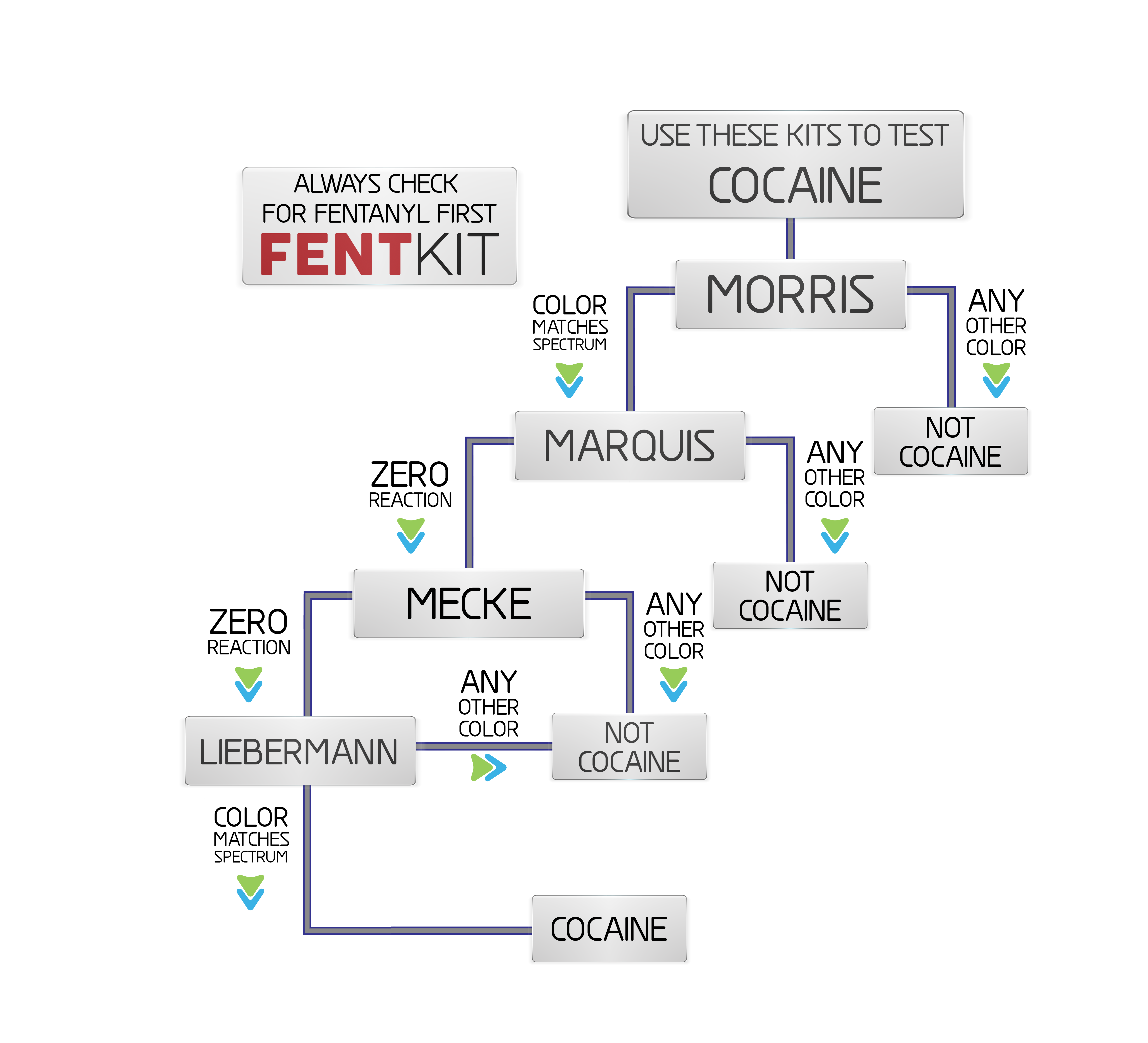
The cocaine testing flow chart. The sections below walk this same path in order.
Test for fentanyl first
Fentanyl-contaminated cocaine has caused thousands of overdose deaths. Our FentKit detects fentanyl and a broad range of its analogs. Dissolve roughly 10 mg in about half a teaspoon of water, dip the strip, and read at five minutes.
Most people who use cocaine have no opioid tolerance, which puts them at extreme risk. Keep naloxone on hand and never use alone.
- They don't detect nitazenes. These potent synthetic opioids are increasingly common and need separate nitazene strips.
- They don't detect every fentanyl analog. Some analogs and novel opioids read negative.
- A negative result only describes the portion you tested. Fentanyl is often unevenly distributed, so one negative strip does not clear the rest. Test multiple spots from a larger batch.
Narrow it to cocaine with Morris
Morris is the most cocaine-specific reagent available for home use, so it runs first. Cocaine turns Morris bright blue to green, and anything else counts as unexpected.

From our official reaction library. Violet-purple points to ketamine or a cathinone rather than cocaine.
Watch full reaction- Crush your sample into a fine powder. Chunks give unreliable results.
- Add one drop of Morris A.
- Then add one drop of Morris B.
- Stir for a full 30 seconds with a toothpick or knife point, then read the color.
Skipping the stir is the most common reason people get a weak, muddy, or absent reaction.
Morris uses cobalt thiocyanate chemistry, which can also produce blue or blue-tinged colors with other local anesthetics (lidocaine, procaine, benzocaine, tetracaine), diphenhydramine, and PCP. Dissociatives give blue-to-purple results that can be mistaken for cocaine's blue. A blue reaction is strong evidence of cocaine, not proof.
Morris reagent color guide with dozens of reference reactions. Also available as the printed booklet in every Morris Spot Test Kit.
Cross-reference with more reagents
Cocaine barely reacts with most other reagents, and that's the point. Run them on fresh samples in the order below, where a strong or unexpected color means something else is present. Every reaction below is from our official reaction library, filmed on verified cocaine.
In the Cocaine Spot Kit Package
The package bundles 10 fentanyl strips with Morris plus these three, cheaper than buying them individually.

Bright orange-to-brown flags amphetamine or methamphetamine.
Watch full reaction
Yellow flags lidocaine, while cocaine and levamisole stay clear. This is your best home screen for lidocaine.
Watch full reaction
Cocaine itself can read clear to orange, so Liebermann can't flag levamisole reliably; see the note below.
Watch full reactionGoing deeper: the full reaction library
Six more reagents from our library, useful for ruling out specific adulterants. For cocaine, most should barely react, with Mandelin and Robadope the exceptions.

One of the few reagents cocaine reacts with, so expect warm tones.
Watch full reaction
Strong dark colors point to opioids or other adulterants.
Watch full reaction
Reacts with primary amines, which helps spot amphetamine-type cuts.
Watch full reaction
A color change suggests something other than cocaine.
Watch full reaction
Purple would mean an indole such as LSD or DMT, never expected here.
Watch full reaction
Blue would flag a secondary amine such as methamphetamine or MDMA.
Watch full reaction- Morris turns violet-purple, pointing to ketamine or a synthetic cathinone rather than cocaine.
- Marquis turns bright orange-brown, flagging amphetamine or methamphetamine.
- Mecke turns yellow, flagging lidocaine.
- Simon's turns blue, a secondary amine like meth or MDMA.
- Ehrlich turns purple, an indole, so the sample is not what it was sold as.
Any of these: do not consume, and see "Your result wasn't what you expected" below.
Common cutting agents
| Cutting agent | How to detect it |
|---|---|
| Fentanyl | Fentanyl test strips |
| Nitazenes | Nitazene test strips; fentanyl strips do not detect these |
| Levamisole | No reliable reagent test; lab analysis required |
| Lidocaine | Mecke reagent: lidocaine reacts yellow while cocaine and levamisole stay clear. Lab analysis to confirm |
| Cathinones | Marquis, Mecke, Liebermann, though it varies by compound and some give no reaction |
| Amphetamine, methamphetamine | Marquis (bright orange to brown), Simon's (blue), Robadope |
| PCP and dissociatives | Morris |
| Baking soda and inert cuts | Purity test, which shows up as a reduced percentage |
Reagent kits were long believed to identify levamisole by a rusty red color with Liebermann. Field testing has since found levamisole-containing samples producing bright yellow and orange-tinged reactions instead, the same range cocaine itself can produce. Because those reactions are inconsistent, we no longer claim reagent tests can identify levamisole. Confirming it requires lab analysis such as FTIR or LC-MS, which our mail-in lab, Transparency Testing, can do. Lidocaine is different: it reacts yellow with Mecke, while cocaine and levamisole stay clear, making Mecke the best home screen for lidocaine.

Test purity
Our Cocaine QTest Kit measures cocaine concentration in powder or solid form from a 20 mg (0.02 g) sample, reporting both a purity percentage and the gram amount of actual cocaine in your sample. Street cocaine varies enormously, from single digits to over 90%. That number tells you how much of what's in front of you is cocaine, and nothing about what makes up the rest.
Purity tests estimate cocaine concentration. They do not identify cutting agents. A sample can read 80% cocaine and still contain a lethal amount of fentanyl in the remaining 20%. Test with strips and spot kits first.
The Cocaine QTest was designed to avoid false positives with levamisole, one of the most common cocaine cuts, but lidocaine can produce a false positive that inflates your purity reading. Screen with Mecke first: lidocaine turns it yellow, while cocaine stays clear. If lidocaine flags, a QTest result can't be trusted.
Record your results
Photograph your results in good light next to the reaction charts. When reagents leave doubt, our mail-in lab, Transparency Testing, provides full analysis using FTIR, LC-MS, NMR, and NIR; see how lab testing works.
- Samples that aren't fully crushed, which matters most for Morris.
- Dim or colored lighting. Bright neutral daylight is best.
- Too much or too little sample. A few milligrams, about a match head.
- Old reagent. It degrades; store it cool and dark, and replace it annually.
- Reading only one reagent. They show what's most abundant, so a minor adulterant can be masked entirely.
Which forms of cocaine can be tested?
Reagents and fentanyl strips work on any form. Purity testing is more restrictive.
| Form | Reagents & strips | QTest purity |
|---|---|---|
| Powder (cocaine HCl) | Yes | Yes |
| Crack / freebase | Yes | True freebase, yes. Street-level crack hasn't been extensively verified, since it often carries adulterants and residual processing components. Screen with spot kits first; if nothing flags, QTest results should be accurate. |
| Liquid cocaine | Yes | No. Measuring the purity of a liquid requires lab analysis; Transparency Testing's Complete Analysis measures purity and identifies major and minor components. |
| Pink cocaine ("tusi") | Yes, though expect non-cocaine results | No. Tusi often contains no cocaine at all, typically ketamine, MDMA, and caffeine, sometimes 2C-B. See our pink cocaine guide. |
Crack and powder cocaine are the same drug pharmacologically; the differences are physical form and route of use, not chemical makeup. Freebase is made by processing cocaine HCl with baking soda or ammonia and heating it, and is typically smoked, which intensifies effects and shortens them, raising overdose and dependence risk.
Your result wasn't what you expected
- Find out what it actually is. Mail a sample to Transparency Testing, our mail-in lab analysis service, the definitive answer where reagents can't give one.
- If an opioid is plausible, have naloxone. Keep it in the room and don't use alone.
- Rule out the test itself. Re-run with fresh reagent, a properly crushed sample, and better lighting before drawing conclusions.
A gentler route than snorting
Long-term snorting damages nasal passages, and "cocaine nose" ranges from irritation and infections to perforated septums. Our SprayPack Kit is a DIY nasal spray for water-soluble substances, a saline-based, more hygienic route that's gentler on nasal tissue and absorbs more completely than snorting. It changes the route of use, not the risk of the substance, and it comes after testing, never before it.
Questions
How accurate are purity tests?
Under good conditions our QTest Kits land within roughly ±5% of laboratory results. Accuracy depends on careful measurement, a properly crushed and representative sample, and unexpired reagent.
Does a good result mean my cocaine is safe?
No. Reagent tests and strips are presumptive, they don't detect everything, and they only describe the portion you tested. Testing lowers your risk of an unpleasant surprise; it doesn't remove risk.
How much do I need to test?
Reagent tests need a few milligrams, about a match head. Strips need roughly 10 mg in half a teaspoon of water. The Cocaine QTest uses 20 mg (0.02 g).
Can I identify cocaine by smell, taste, or mouth numbness?
No. Cocaine is often described as bitter or chemical-smelling with a numbing effect, but many other substances share those traits, and lidocaine, a common cut, mimics the numbing specifically. Smell and taste tell you nothing about identity, purity, or adulterants. Testing is the only way to know.
How do I know if levamisole is in my cocaine?
You can't confirm it with a reagent kit; see the note above. It needs lab analysis through Transparency Testing. Levamisole is a veterinary dewormer commonly used to cut cocaine and can cause serious harm including neutropenia and skin necrosis.
Ready to test?
Serious drug checking at home. Orders ship within 24 hours.
Free shipping over $75 · Discreet packaging
More resources
- Our types of test kits
- QTest purity kit basics
- Skylab separation kit basics
- How to test for nitazenes: why fentanyl strips aren't enough
- Pink cocaine ("tusi"): everything you need to know
- Reaction video library: watch colors develop in real time
- Spectrum color guide
A sample that has been tested should not be considered safe. There is inherent risk when choosing to consume any substance.
Many factors are involved when conducting a test and examining reactions, and The Bunk Police does not assume responsibility for the interpretation of results. Reactions of individual samples can vary depending on lighting differences and the specific mixtures of substances being tested.
Bunk Police kits are intended for identifying unknown substances for harm reduction purposes only. The Bunk Police does not assume responsibility for the use or misuse of this information. Proceed at your own risk.