How To Test Mescaline
How to Test Mescaline, including Cactus Material (2026 guide)
Testing something sold as mescaline? Start here
The risk here isn't a cutting agent diluting a dose. It's a different compound entirely, active at a fraction of the weight.
Mescaline is a naturally occurring phenethylamine psychedelic. It's found in the San Pedro and peyote cacti and also sold as an extract, and it reaches people in three main forms: dried cactus material, cactus powder in capsules, and loose powder or crystal sold as extracted mescaline. What arrives under its name is often something else: a 2C compound, a DOx such as DOB, DOC or DOM, an NBOMe, a related escaline, or a tryptamine, several of them active at a small fraction of mescaline's weight. The hazard isn't a cutting agent diluting a dose, it's a stronger compound standing in for the whole thing.
The tests on this page are reagent spot tests (Marquis, Mecke and Froehde, with a wider cross-reference set) and, for powders, a fentanyl strip. A reagent drops onto a few milligrams of sample and turns a color that narrows it toward or away from a family of compounds. That's where the answer stops: a color can rule mescaline out or place your sample in a group, yet no reagent names the molecule, and ground cactus barely reacts at all. Read this page for what the tests rule out, not for permission to dose.
Common mescaline terminology
New to this? These are the words the rest of the page uses. Tap any term to expand it.
Mescaline
A naturally occurring phenethylamine psychedelic with an active dose measured in hundreds of milligrams. That large dose is itself a clue: anything sold as mescaline that works at a few milligrams is something else.
San Pedro and peyote
The cacti mescaline comes from, sold as dried material, capsules of powder, or ground plant. Mescaline is a small and highly variable fraction of their dry weight, which is why reagents read cactus so poorly.
Phenethylamine
The chemical class mescaline belongs to, alongside the 2C, DOx and NBOMe compounds sold in its place. Sharing that class is part of why several substitutes give overlapping reagent colors.
Reagent (spot) test
A drop-on color test that's presumptive: it narrows a sample toward or away from a family and never names a specific compound on its own. Only laboratory analysis identifies which molecule is present.
Marquis, Mecke, Froehde
The three reagents in the mescaline package. Marquis opens the screen, Mecke does the most cross-reference work, and Froehde flags substitutes; no one of them, and no combination, confirms mescaline.
Substitute vs cutting agent
A cutting agent dilutes a drug; a substitute replaces it with a different compound. What's sold as mescaline is usually substituted rather than cut, and the substitutes are frequently far stronger by weight.
2C compounds
Phenethylamines such as 2C-B and 2C-E, active in the single-digit to tens of milligrams. Marquis leans yellow-green rather than mescaline's orange, though the two can be hard to separate by eye.
DOx compounds (DOB, DOC, DOM)
Long-acting phenethylamines active at roughly 1 to 3 mg. A dose-sized scoop of one in place of mescaline is a large overdose, and reagent color alone won't reliably single them out.
NBOMe
A group of phenethylamines (25I, 25B, 25C and relatives) active below a milligram and linked to deaths. They give little or no Marquis color, so a weak reaction is a reason to stop, not a pass.
Fentanyl strip
An immunoassay strip that screens a dissolved powder for fentanyl. It describes only the portion you tested, misses many analogs, and doesn't detect nitazenes.
Which test do I need?
The question that matters most. Needs Marquis plus at least one cross-reference.
Shop the packageMarquis is the right first kit, but it can't name mescaline on its own.
Shop Marquis — $20Reagents can't resolve this one; a lab can.
Transparency Testing lab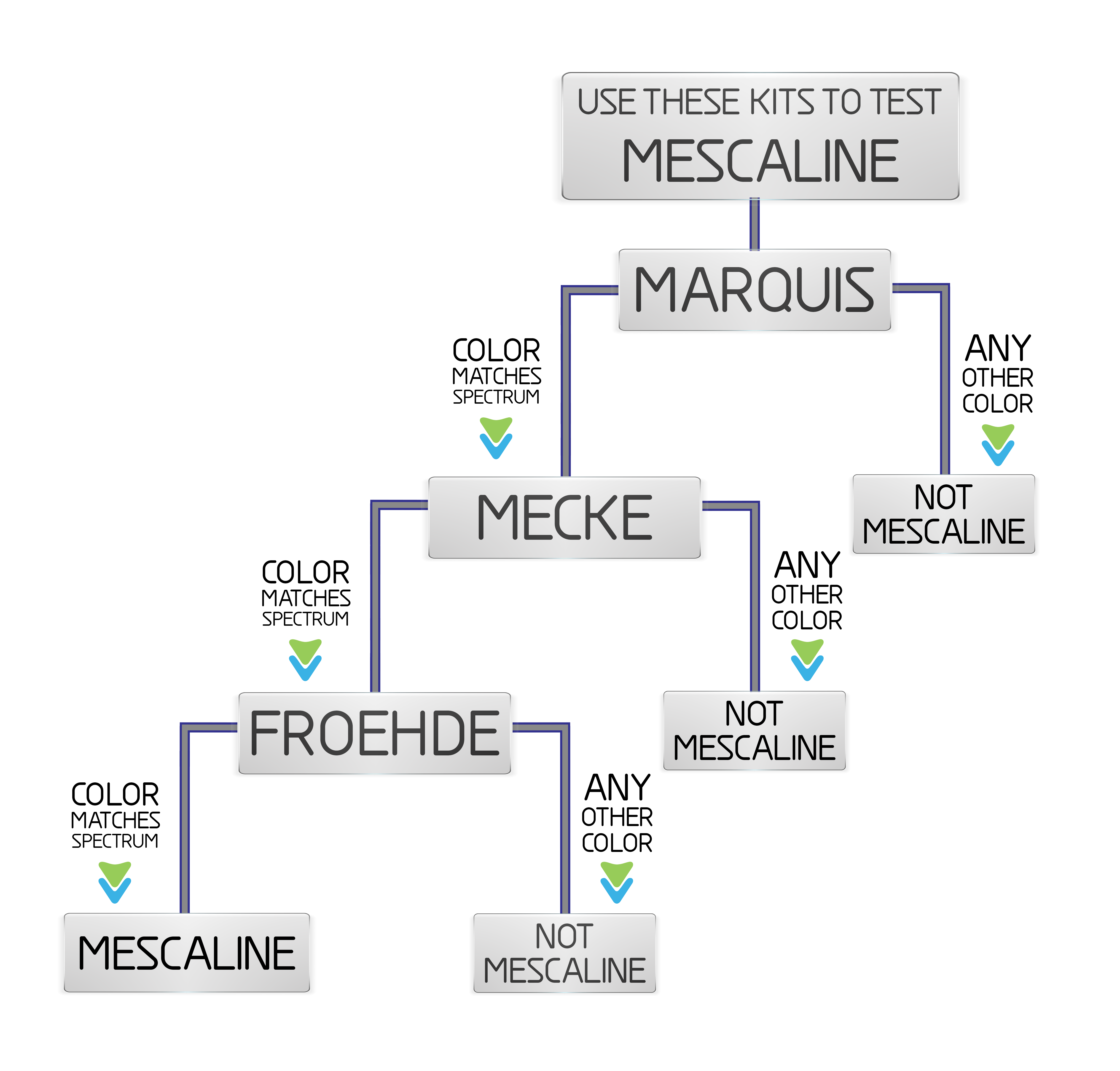
The mescaline testing flow chart. The sections below walk this same path in order.
Test for fentanyl first
If what you have is a powder rather than cactus material, run a strip before anything else. Mescaline is active in the 200–500 mg range, which means you would be swallowing a large amount of an unverified powder, far more material than with most substances, so anything present alongside it comes along in quantity too. Dissolve roughly 10 mg in about half a teaspoon of water, dip the strip, and read at five minutes.
- They don't detect nitazenes. These potent synthetic opioids are increasingly common and need separate nitazene strips.
- They don't detect every fentanyl analog. Some analogs and novel opioids read negative.
- A negative result only describes the portion you tested. Contamination is often uneven, so one clean strip does not clear the rest of a batch.
What color should mescaline turn?
Mescaline gives a strong yellow-orange with Marquis. So do amphetamine and methamphetamine; orange to brown is their expected Marquis result too. An orange Marquis reaction narrows your sample down to a group of compounds; it does not name mescaline, and on its own it does not distinguish mescaline from a stimulant.
We previously told readers that if they could only buy one kit, Marquis would identify mescaline. That was wrong and we've removed it. Marquis is the right place to start, but you need at least a second reagent, and for anything that isn't plainly cactus you should assume you need lab analysis through Transparency Testing to actually know.
Every reaction below is from our official reaction library, filmed on verified mescaline. Read yours against the printed booklets in bright, neutral daylight; orange versus yellow-green is a hue judgment, and warm indoor light will mislead you.
The package trio: Marquis, Mecke, Froehde

Marquis is the starting point: amphetamine and meth give the same orange-to-brown, so this narrows the field without naming it. Yellow-green points to a 2C or DO compound instead.
Watch full reaction
The cross-reference that does the most work. Yellow-brown-red alongside an orange Marquis is the pattern you're looking for. Deep blue-green suggests an opioid instead.
Watch full reaction
A third-pass check: a strong green, or a fast green-to-black, points to a substituted phenethylamine, so stop.
Watch full reactionGoing deeper: the full reaction library

Mandelin is naturally mustard yellow, so run a blank drop alongside for comparison.
Watch full reaction

Yellow, not purple: mescaline is a phenethylamine, not an indole. A purple here means a tryptamine or lysergamide instead.
Watch full reaction
Mescaline is a primary amine, so Robadope reacts, which adds one more data point without naming the compound.
Watch full reaction- Marquis goes yellow-green to green: a 2C or DO compound, active at a fraction of a mescaline dose. It may take 5–10 seconds or longer and keep changing.
- Marquis gives little or no color: the NBOMe pattern, and the most dangerous cell on this page. A weak reaction is a reason to stop, not reassurance.
- Marquis goes purple-black almost immediately: MDMA or MDA, not mescaline.
- Mecke goes deep blue-green: opioid territory, not the yellow-brown-red of mescaline.
- Froehde goes strong green, or green-to-black fast: a substituted phenethylamine such as allylescaline. Stop.
- Ehrlich goes purple: an indole such as a tryptamine or lysergamide, not mescaline.
Marquis reagent color guide: the reference for separating orange from yellow-green, the distinction that matters most here. Printed booklet included with every Marquis Spot Test Kit.
Mecke reagent color guide: compare your yellow-brown-red against the reference plates and against the opioid blue-greens. Printed booklet included with the Mecke Spot Test Kit.
Froehde reagent color guide: the reference plates for the 2C and DO compounds Froehde is here to flag. Printed booklet included with the Froehde Spot Test Kit.
Froehde's main job on this page is flagging substitutes. It reacts distinctly with several of the compounds most likely to be sold as mescaline: a strong green, or a fast green-to-black, says "not mescaline, and probably something much more potent." A strong unexpected reaction is a reason to stop.
The reaction library's reference for Froehde on verified mescaline is the yellow-to-brown shown above. Use it as a comparison point, not a pass stamp: a yellow-brown Froehde alongside the expected Marquis and Mecke results supports the mescaline pattern, but no combination of these three reagents confirms it.
- Crush to a fine, even powder. Chunks only expose their surface to the reagent.
- Split into a few milligrams for each reagent, each in its own test tube. One tube per spot kit.
- Marquis first, one drop. Note the speed as well as the final color.
- Mecke second, on a fresh portion. Then Froehde on a third portion.
- Read all three in bright, neutral daylight against a white background. Orange versus yellow-green is a hue judgement, and warm indoor light will mislead you.
Testing cactus material
Most of what's sold as mescaline in person is dried San Pedro or peyote: ground plant material, sometimes in capsules, sometimes as a brown or green powder. Reagent kits handle this badly, which is worth knowing before you spend a kit on it.
- The plant matrix produces its own colors. Chlorophyll, sugars, plant pigments and other alkaloids all interact with strong acid reagents. What you see is a mixture of reactions, not the mescaline reaction.
- Mescaline is a small fraction of the dry weight. In dried cactus it's typically a low single-digit percentage at best, and it varies enormously between plants, parts of the plant, and growing conditions. A few milligrams of cactus powder may contain well under a milligram of mescaline, not enough to drive a clear reaction.
- A weak or absent result on cactus material means nothing. It does not indicate the absence of mescaline, and it does not indicate low potency.
- A strong unexpected color still matters. If ground plant material gives a fast, saturated purple-black or a vivid green, something has been added. That's worth acting on.
If you need to know what's in cactus material, or how much, lab analysis through Transparency Testing is the honest answer, and plant preparations are on their accepted list. If you only have reagents, use them to look for red flags and accept that they can't name what's there.
These are substitute actives, not cutting agents
This section matters more than any other here, and we had it framed wrongly for years. The compounds below were once listed as "cutting agents" our reagents could detect. They aren't cutting agents. A cutting agent dilutes a drug; these replace it entirely with different psychedelics sold as mescaline, several of them active at a small fraction of mescaline's weight.
Mescaline's active dose is roughly 200 to 500 mg. 2C-B is active in the tens of milligrams, DOC and DOB at roughly 1 to 3 mg. The NBOMe compounds (25I-NBOMe, 25B-NBOMe, 25C-NBOMe and their relatives) are active below a milligram, and are associated with deaths at doses people believed were moderate.
Measure out 300 mg of powder expecting mescaline when it's actually DOB, and you're holding something in the region of a hundred times an active dose. If it's an NBOMe, the multiple is larger still. This is why an unexpected color on this page isn't a disappointment about purity; it's a warning about an order-of-magnitude overdose.
It's also why the substantial size of a real mescaline dose works in your favor: anyone selling "mescaline" that's active at 20 mg isn't selling mescaline.
| Compound | Roughly how much is active | How to flag it |
|---|---|---|
| Mescaline (for comparison) | 200–500 mg | Marquis yellow-orange plus Mecke yellow-brown-red. Suggestive together, but no reagent pairing names it; only a lab does that |
| 2C-B, 2C-C, 2C-D, 2C-E, 2C-I, 2C-P | Single-digit to tens of milligrams, varying by compound | Marquis yellow through green rather than orange, often slower to develop. Froehde also reacts distinctly. See the 2C-B reaction library |
| DOB, DOC, DOM | Around 1–3 mg | Marquis in the olive-green to yellow range rather than orange. Long duration is the other tell, but that only shows once it's too late to matter |
| 25I-NBOMe, 25B-NBOMe, 25C-NBOMe, 25D-NBOMe, 25E-NBOMe, 25N-NBOMe | Below 1 mg | Hard to flag with reagents. Documented to give little to no Marquis color or only a faint orange. A weak reaction is a red flag, not a pass |
| 2C-B-FLY, BK-2C-B, 2C-BZ, TMA-6, 3C-E | Varies; generally well below mescaline | Cross-reference all three reagents and treat any color outside the expected pattern as unexpected |
| Escaline, proscaline, allylescaline | Lower than mescaline, varying by compound | Closely related to mescaline and hardest of all to separate by reagent. Allylescaline is documented to give a fast green-to-black with Froehde |
| 4-AcO-DALT, 4-HO-MET, 4-HO-MiPT, 5-MeO-AMT, AMT | Varies widely; 5-MeO-AMT in particular has a narrow margin | Tryptamines rather than phenethylamines. Reagents in this package are a poor fit; these are better approached with Ehrlich or Hofmann, where Ehrlich purple instead of mescaline's yellow is the tell |
| MDMA or MDA | Tens to low hundreds of milligrams | Marquis purple to black, almost immediately |
| Amphetamine or methamphetamine | Tens of milligrams | Marquis orange to brown, the same color as mescaline. This is the confusion Marquis alone can't resolve |
Two corrections to the compound list we used to publish, in case you're comparing against an older version of this page: 4-ACO-DALT should be 4-AcO-DALT; "DOM25E-NBOMe" was two separate compounds run together, DOM and 25E-NBOMe; 25I-NBOMe capitalisation was inconsistent; and 5-APB succinate has been removed. That last one is a benzofuran salt with no business in a mescaline substitution list.
Cross-reference with the package
The Mescaline Spot Kit Package is $45 and costs less than buying the three kits individually.
- Marquis reagent
- The starting point. Yellow into strong orange is consistent with mescaline, but also with amphetamine and methamphetamine. Yellow-green points to a 2C or DO compound instead.
- Mecke reagent
- The cross-reference that does the most work. Yellow through brown to red alongside an orange Marquis is the pattern you're looking for in a powder.
- Froehde reagent
- Third-pass check. Yellow-brown is the library reference for mescaline; a strong green or fast green-to-black flags a substituted phenethylamine.
Running all three is the point. No pair of these reagents confirms mescaline, but three results that all sit outside the expected pattern is a clear signal to stop.
If it came as a powder of unknown origin
Extracted mescaline sold as loose powder has passed through the same supply chains as everything else. Opioid contamination is far less common here than with stimulants or counterfeit pills, but strips are cheap relative to the consequence, and the amount of powder involved in a mescaline dose is large. Our FentKit is $12.50: dissolve roughly 10 mg in about half a teaspoon of water, dip, and read at five minutes. Strips don't detect nitazenes, which need separate nitazene strips, and a negative only describes the portion you tested.
Can you test purity?
Not at home. We don't make a mescaline QTest, and the MDMA, cocaine, LSD, psilocybin and cannabis QTest kits are calibrated for their own substances; none of them will give you a meaningful mescaline number.
The nearest option is a Juno separation package. Skylab separation kits split a mixture into its components so you can test each one and get an approximate sense of how much of each is present, which is useful on a powder blend. For an actual concentration, and for anything involving cactus material, Transparency Testing's mail-in lab analysis is the answer.
Step by step
- Look at the quantity first. A mescaline dose is 200 to 500 mg of material. If what you've been sold is meant to be a dose and it's a fraction of that, stop here, because no reagent result will make that add up.
- Crush and split. A few milligrams per reagent, each in its own test tube.
- Run Marquis first: one drop, and watch the first ten seconds. Yellow into strong orange is the result consistent with mescaline. Yellow-green points elsewhere; a faint or absent reaction is a red flag, not a pass.
- Run Mecke. Yellow through brown to red alongside that orange is the pattern you want. A blue-green suggests an opioid instead.
- Run Froehde: yellow-brown matches the library reference. Strong green, or a fast green-to-black, means stop.
- If it's cactus material, expect a messy result and don't draw conclusions from a weak one. Look only for strong unexpected colors.
- Record it. Photograph all three reactions in daylight next to the booklets, and send unresolved samples to Transparency Testing for a definitive answer.
- Reading a faint reaction as a good sign. On this page a weak reaction is the NBOMe pattern.
- Judging orange versus yellow-green under warm indoor light. Use daylight and the printed booklet.
- Reading only the first few seconds. 2C compounds can take 5–10 seconds or longer and may keep changing.
- Expecting a clean result from plant material. Cactus powder gives a mixture of reactions.
- Using one reagent. Marquis alone cannot separate mescaline from amphetamine.
- Too much sample, which drives reactions to black, or too little, which gives nothing.
- Old reagent. It degrades, so store it cool and dark, and replace it annually.
- Treating three ambiguous results as one good result.
Your result wasn't what you expected
- Find out what it actually is. Mail a sample to Transparency Testing, our mail-in lab analysis service and a definitive answer where reagents can only narrow the field. On this page that matters more than most, because the substitutes are potent by weight and a wrong guess is a dosing error of orders of magnitude.
- Do not fall back on "I'll just take less." With an unidentified milligram-active compound you don't know what "less" is.
- If an opioid is plausible, have naloxone in the room. Never use alone.
- Rule out the test itself. Re-run with fresh reagent, a properly crushed sample, and better lighting before drawing conclusions.
Questions
Can Marquis on its own tell me it's mescaline?
No. Mescaline gives a yellow-to-strong-orange with Marquis, and orange to brown is also the expected Marquis result for amphetamine and methamphetamine. Marquis narrows it down to a group. It's still the right first kit, because a yellow-green or purple-black result rules mescaline out immediately, though it can't rule mescaline in.
How do I tell mescaline from LSD?
Mostly by form and quantity, before you get to reagents. LSD comes on blotter, in gel tabs or in liquid at microgram doses; mescaline is a few hundred milligrams of powder or a substantial amount of cactus. If someone has sold you blotter as mescaline, the dose doesn't work and something else is on it. For blotter, see how to test LSD.
My cactus powder barely reacted. Is there no mescaline in it?
You can't conclude that. Mescaline is a small and highly variable fraction of dried cactus, and plant material interferes with reagent reactions in both directions. A weak result on cactus material is not informative either way.
What if the color is somewhere between orange and green?
Treat it as unexpected and don't consume it. That's exactly the ambiguous zone where a 2C compound and mescaline are hard to separate by eye, and the consequences of guessing wrong are asymmetric: mescaline at a 2C dose does very little, while a 2C at a mescaline dose is a serious overdose.
How much sample do I need?
A few milligrams per reagent, about a match head, each in its own test tube. With cactus material you'll want more, and should still expect an unclear result.
Does a clean set of results mean my sample is safe?
No. Reagents are presumptive, they only describe the portion you tested, and they report what's most abundant rather than what's most dangerous. Testing lowers your risk of an unpleasant surprise; it doesn't remove risk.
Ready to test?
Serious drug checking at home, with orders shipped within 24 hours.
Free shipping over $75 · Discreet packaging
More resources
- Mescaline reaction video library: every reaction above, in full, plus substance info
- Before you Nexus flip: what to know about 2C-B: the most common substitute, in depth
- Our types of test kits
- Skylab separation kit basics
- How to test LSD: for blotter and gel tabs
- How to test MDMA: if your Marquis went purple-black
- How to test amphetamine: the other substance that gives an orange Marquis
- Spectrum color guide
- Lab testing with Transparency Testing: for cactus material and anything unresolved
A sample that has been tested should not be considered safe. There is inherent risk when choosing to consume any substance.
Many factors are involved when conducting a test and examining reactions, and The Bunk Police does not assume responsibility for the interpretation of results. Reactions of individual samples can vary depending on lighting differences and the specific mixtures of substances being tested.
Bunk Police kits are intended for identifying unknown substances for harm reduction purposes only. The Bunk Police does not assume responsibility for the use or misuse of this information. Proceed at your own risk.