How To Test DMT
How to Test DMT and DMT Vape Liquid (2026 guide)
Testing DMT? Start here
Most DMT, especially in vape form, is unverified. Find out what's in your sample before you decide anything about it.
DMT (N,N-dimethyltryptamine) is a tryptamine psychedelic, sold most often as a freebase powder or crystal and, increasingly, as vape liquid in prefilled cartridges. Freebase is the most common street form; it also turns up as a salt, and in cartridges the material is dissolved into propylene glycol, vegetable glycerin or PEG. What's sold as DMT isn't always DMT: other tryptamines such as 5-MeO-DMT, DPT, 4-HO-MET, 4-HO-MiPT and MiPT get substituted for it, bulking agents like pyridoxine (vitamin B6) pad it out, and some samples are an unknown research chemical or LSD instead.
This page covers reagent color tests and, before them, a fentanyl strip on any unknown powder. Powder and crystal take Hofmann plus Mecke; vape liquid takes Ehrlich plus Hofmann, because the carrier solvent fouls Mecke. All of these are presumptive: a color places a sample in the indole or tryptamine family and rules a few substitutes out, yet no reagent names which tryptamine you're holding, and a strip's negative describes only the portion you tested. Read this page for what the tests rule out, not for permission to dose.
Common DMT terminology
New to this? These are the words the rest of the page uses. Tap any term to expand it.
DMT (N,N-dimethyltryptamine)
A tryptamine psychedelic sold as powder, crystal or vape liquid. Home reagents can place a sample in its chemical family, but they can't single DMT out from related tryptamines on their own.
Freebase and salt
The two solid forms DMT comes in, with freebase being the most common street form. Salt and freebase react in the same reagent families but arrive slightly differently, so compare against the reference set that matches your material.
Vape cartridge and carrier solvent
DMT vape liquid is DMT dissolved in propylene glycol (PG), vegetable glycerin (VG), PEG or a blend. The solvent reacts with Mecke and hides the DMT reading, which is why cartridges need Ehrlich plus Hofmann rather than the powder kit.
5-MeO-DMT
A far more potent relative sometimes sold as DMT or mixed into it. Hofmann's color can hint at the difference but can't tell the two apart reliably, so a green result is a reason to stop, not an identification.
Tryptamine and indole
Tryptamines are the chemical family DMT belongs to, each built around an indole ring. Reagents detect that ring, which is why they flag the whole family at once instead of naming one member.
Reagent (spot) test
A drop-on color test that's presumptive: it narrows a sample toward or away from a family and never names the specific compound on its own. Only laboratory analysis confirms which molecule is present.
Hofmann, Ehrlich and Mecke
The three reagents used on this page. Hofmann is primary for DMT and separates lysergamides (deep blue) from other indoles; Ehrlich flags any indole but reads slowly; Mecke cross-references dry powder or crystal only, never vape liquid.
Fentanyl strip (immunoassay)
An antibody-based strip that screens a dissolved sample for fentanyl. A negative describes only the portion you tested, and the strip doesn't detect nitazenes or every fentanyl analog.
Presumptive
A result that points toward or away from a substance without proving it. Reagent colors and strip results are presumptive; naming the exact compound takes a laboratory.
Which test do I need?
Hofmann plus Mecke. Read Hofmann first, cross-reference with Mecke on a fresh spot.
DMT Spot Kit Package ($35)Ehrlich plus Hofmann. Neither reacts to PG, VG or PEG. Do not use Mecke.
LSD Spot Kit Package ($35)Separation testing, then reagents on each fraction.
Juno Separation Package ($120)No home kit can do this. Instrumental analysis can.
Transparency Testing lab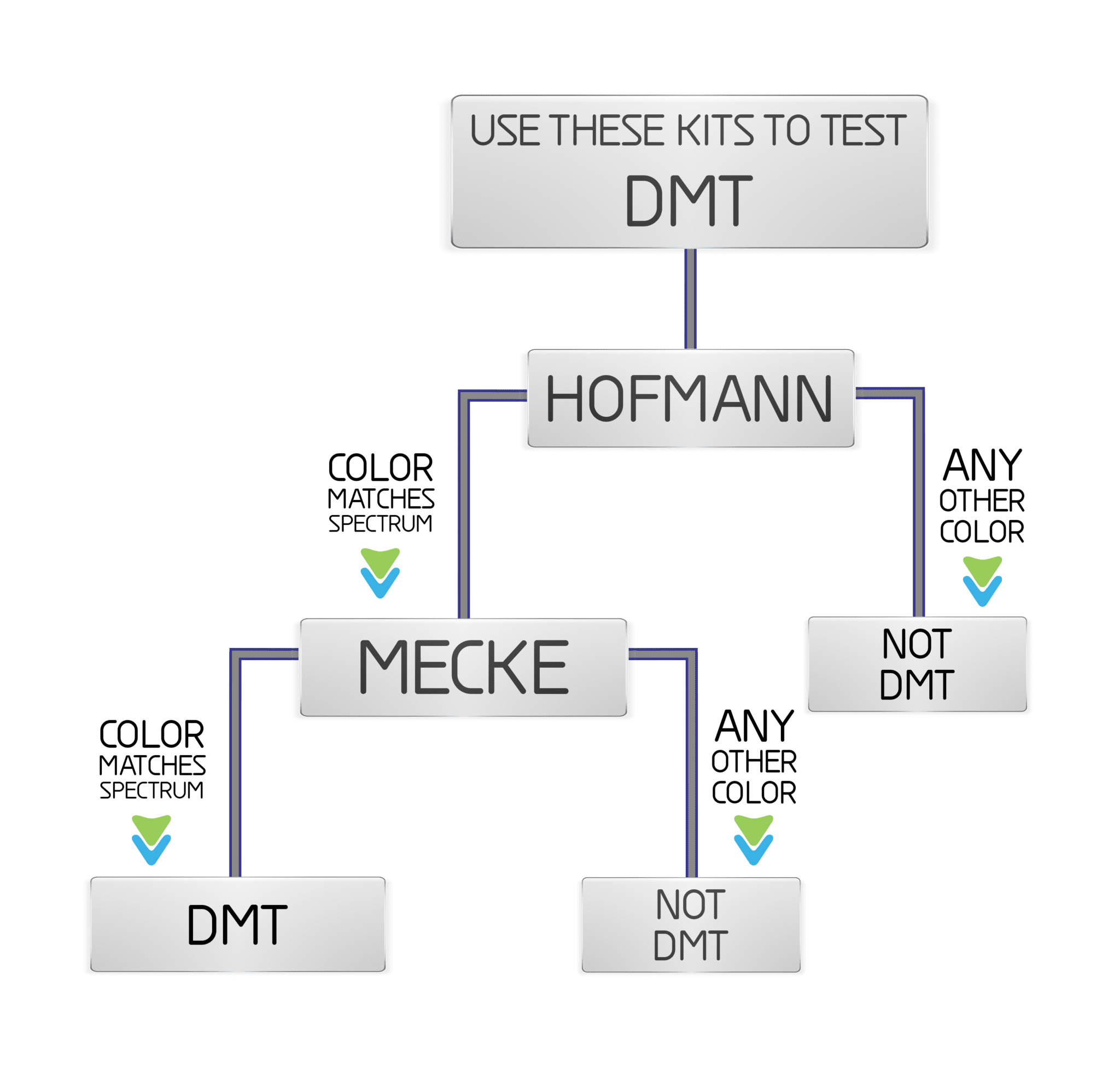
The DMT testing flow chart. The sections below walk this same path in order.
Test for fentanyl first
DMT usually arrives as a freebase powder or crystal, and any unknown powder is worth a strip before you reach for a reagent. Contamination isn't common in DMT specifically, but checking costs a few milligrams and five minutes. Dissolve roughly 10 mg in about half a teaspoon of water, dip the strip, and read at five minutes. For vape liquid, put a drop of the liquid into the water instead.
- They don't detect nitazenes. These potent synthetic opioids are increasingly common and need separate nitazene strips.
- They don't detect every fentanyl analog. Some analogs and novel opioids read negative.
- A negative result only describes the portion you tested. Contamination is often uneven, so one clean strip does not clear the rest of a batch.
What color should DMT turn?
Hofmann is the primary reagent for DMT. It can't name DMT on its own; it narrows a sample down to a non-lysergamide indole, which is a real and useful step but a long way short of an identification. Read Hofmann alongside Ehrlich. Both reactions below are from our official reaction library, filmed on verified DMT.

The primary test. Yellow, often drifting yellow-green over minutes. Deep blue means a lysergamide, not DMT.
Watch full reaction
Shows an indole is present, and that's all it means. Wait the full five minutes before calling it negative.
Watch full reaction5-MeO-DMT is active at a fraction of a DMT dose, so getting this wrong is the most dangerous mistake available on this page. The underlying chemistry, DMT yellow and 5-MeO-DMT green, is real but weak, and there are four reasons not to lean on it.
- It's a hue judgment, and hue judgments fail. Yellow and green sit next to each other. Indoor lighting, a tinted plate, or a colored sample shifts what you see.
- DMT itself drifts green. A DMT reaction that starts yellow commonly moves toward yellow-green over several minutes. Read late and you can call DMT "green."
- A mixture hides it. If a sample is mostly DMT with 5-MeO-DMT alongside it, the DMT signal dominates and the result looks like ordinary DMT.
- Green isn't specific either. Non-psychoactive 5-HTP also gives a fast green.
Treat a green Hofmann as a reason to stop, not as an identification. If you need to know which tryptamine you have, that takes instrumental analysis; our mail-in lab, Transparency Testing, can do it.
Hofmann reagent color guide, dozens of reference reactions side by side. Also supplied as the printed booklet with every Hofmann Spot Test Kit.
- Put a few milligrams, about a match head, on a clean white ceramic plate. Crush any chunks.
- Add 1–2 drops of Hofmann. One drop is enough for a small sample; too much reagent dilutes the color.
- Note the first color within 30 seconds.
- Keep watching to 5 minutes and note whether it shifts. The drift matters as much as the first color.
- Photograph it in bright neutral daylight, next to the booklet page, before you draw a conclusion.
- Fresh sample on a clean spot of the plate. Never re-use the spot you ran Hofmann on.
- Add 1–2 drops of Ehrlich.
- Wait the full 5 minutes. Most reagents are read inside the first 40 seconds or so; Ehrlich is the exception. Reading at 20 seconds and seeing nothing is the single most common way people wrongly conclude there's no indole in the sample.
- A purple, or a pink deepening toward magenta, means an indole is present. It does not mean DMT is present.
Ehrlich reagent color guide. Notice how many unrelated compounds give the same purple, which is the point of the caveat above. Printed booklet included with the Ehrlich Spot Test Kit.
- Ehrlich is not specific to DMT. It detects the indole ring. LSD, 1P-LSD, psilocin, psilocybin, 4-AcO-DMT, 5-MeO-DMT, MiPT, melatonin, 5-HTP and tryptophan all give the same purple. Pyridoxine, which is vitamin B6 and a plausible bulking agent, gives a pink that reads as a positive.
- Hofmann separates lysergamides from other indoles, not one tryptamine from another. Lysergamides go deep blue; everything else in the indole family goes into the yellow-to-green range together.
- Mecke does not rule out synthetic tryptamines. We used to say it did. It doesn't: 5-MeO-DMT, 4-HO-MiPT, 4-HO-MET and DPT are all reactive with the same reagents DMT is, and none of these three reagents reliably tells them apart.
- Reagents show what's most abundant. A minor component of a mixture can be masked completely by the major one.
- None of them measure how much. Reagents say "something like this is here," never "this much of it."
Cross-reference with more reagents
Every reaction below is from our official reaction library. DMT reacts with more reagents than cocaine does, so the point of cross-referencing isn't "no reaction is good"; it's whether each color matches the reference. Note that DMT salt and DMT freebase react slightly differently, so test against the set that matches your material.
DMT (salt)

Dry powder or crystal only, never vape liquid.
Watch full reaction
A strong dark color would be unexpected.
Watch full reaction
Blue would flag a secondary amine like meth or MDMA instead.
Watch full reaction
Warm tones are the expected range.
Watch full reaction
Dark brown-black with yellow edges is normal for DMT.
Watch full reaction
Little to no reaction is normal; a strong color means something else is present.
Watch full reaction
Reacts with primary amines, so it helps spot amphetamine-type cuts.
Watch full reactionDMT freebase
Freebase is the most common street form. Reactions run in the same families but arrive slightly differently, so compare against these, not the salt set.


Arrives through yellow-pink rather than straight purple. Same rule: wait five minutes.
Watch full reaction


- Hofmann turns deep blue: a lysergamide such as LSD or an analog, not DMT, and lysergamides are active at microgram scale.
- Hofmann goes green early, with no yellow stage: suggestive of 5-MeO-DMT, so stop and see the warning above.
- Simon's turns blue on powder sold as DMT salt: a secondary amine like meth or MDMA may be present.
- No reaction to anything: probably not an indole, so not DMT.
- Any color not in the booklets: an unknown; do not consume.
Any of these: do not consume, and see "Your result wasn't what you expected" below.
How to test DMT vape liquid
Vape liquid needs a different kit from powder, and the reason is the solvent, not the DMT.
DMT cartridges use propylene glycol (PG), vegetable glycerin (VG), PEG, or a blend, commonly 70:30 or 50:50 PG to VG, since DMT doesn't fully dissolve in vegetable glycerin alone. Our chemists tested DMT at 1 g to 3 ml of each solvent. The solvent itself reacts with Mecke, producing a yellow-to-orange that sits on top of and obscures DMT's greenish-brown. It isn't that the glycol blocks DMT from reacting; it's that the glycol adds its own color and you can no longer read the DMT one. That held for PG, PEG and glycerin alike.
Ehrlich and Hofmann react to DMT's indole structure and don't react to the solvents, so they stay usable. In our vape-liquid tests both ran slightly slower and finished slightly fainter than they do on dry DMT, another reason to wait the full read time. Here's DMT in propylene glycol with all four reagents, from the reaction library:

Usable on vape liquid. Slower and fainter than on dry DMT.
Watch full reaction
Usable on vape liquid. Wait the full five minutes.
Watch full reaction
Don't use for a decision: the solvent's own color hides the DMT reading. Shown for reference.
Watch full reaction
Also affected by the solvent, shown for reference, not for decisions.
Watch full reaction

All of our DMT vape reaction videos, including the glycerin and PEG series, are in our Vimeo showcase, alongside 300+ other substances.
- Drop the liquid out of the cartridge onto your plate. Never drop reagent into the cartridge; that makes the whole cart toxic to inhale.
- Remove the mouthpiece, unscrew the vial, hold it upside down and let a few drops fall. If it won't flow, draw it with a syringe.
- Warm it if it's thick: a hairdryer on the cart, or seal the cart in a bag and sit it in warm water.
- Test one drop of liquid with Ehrlich and, on a separate spot, one drop with Hofmann.
- If the cartridge can't be opened at all, it can't be tested.
The DMT Spot Kit Package contains Mecke and is the right kit for powder. For cartridges use the LSD Spot Kit Package, which is Ehrlich plus Hofmann. If you've already run Mecke on vape liquid and got yellow or orange, that result tells you nothing about the DMT; discard it rather than interpreting it.
What's in the DMT Spot Kit Package
- Hofmann reagent
- The primary test. Yellow, drifting yellow-green, for DMT. Deep blue means a lysergamide instead.
- Mecke reagent
- Cross-reference on dry material only: yellowish to greenish-brown. Not for vape liquid.
- Printed color booklets
- Reference reactions for both reagents, to compare against side by side under the same light.
For vape cartridges buy the LSD Spot Kit Package instead: Ehrlich plus Hofmann, neither of which reacts to the carrier solvent. Both packages are $35; a single reagent is $20.
Mecke reagent color guide, for dry powder or crystal, never vape liquid. Printed booklet included with every Mecke Spot Test Kit.
Common DMT substitutes and adulterants
The honest summary is that home reagents are good at telling you a tryptamine is present and poor at telling you which one. Everything in this table reacts with the same reagents DMT does.
| Substitute or adulterant | What reagents show | What it takes to actually confirm |
|---|---|---|
| 5-MeO-DMT | Ehrlich purple, Hofmann in the yellow-green range. A fast green rather than yellow is suggestive, not proof | Lab analysis. Dose difference is large enough that guessing is not acceptable |
| DPT | It's a tryptamine, so it reacts with Ehrlich and Hofmann as well as Mecke. No reagent in this set separates it from DMT | Lab analysis |
| 4-HO-MET, 4-HO-MiPT | Ehrlich purple, Hofmann yellow-green, Mecke reacts. Indistinguishable from DMT by color | Lab analysis |
| MiPT, 5-MeO-MiPT | Same again: indole reagents react, none discriminate | Lab analysis |
| LSD and LSD analogs | Hofmann deep blue. This one reagents do catch | Hofmann is sufficient to say "not DMT." Which lysergamide it is needs a lab |
| Pyridoxine (vitamin B6) and other bulking agents | Pink with Ehrlich, which reads like a positive | Lab analysis, or a separation kit to show a second component is present |
| Inert filler in a mixture | Nothing; reagents can't see it behind the DMT reaction | Separation testing, or lab analysis |
| An unknown research chemical | Possibly no reaction at all, or something not in any booklet | Lab analysis. Do not consume |
Estimating how much of each substance is present
Reagents don't measure concentration. Our Juno Separation Package ($120) physically separates the components of a mixture so you can test each one on its own and get an approximate sense of the proportions. The Curiosity Pro Level Package ($185) adds every reagent we make.
Separation kits give you an approximate composition, not a measurement. They cannot identify a compound you don't have a reference reaction for, and they cannot tell 5-MeO-DMT from DMT any better than Hofmann can. For a definitive answer, send a sample to our mail-in lab, Transparency Testing; see how lab testing works.


Step by step
- Work out which sample type you have. Powder and crystal take Hofmann plus Mecke. Vape liquid takes Ehrlich plus Hofmann.
- Run Hofmann. A match-head of powder, or one drop of liquid, on a clean white ceramic plate. 1–2 drops of reagent. First color by 30 seconds, then watch to 5 minutes and note any drift.
- Run the second reagent on a fresh spot. Never re-use a spot or a stirrer. For powder, run Mecke and read within 60 seconds. For liquid, run Ehrlich and wait the full 5 minutes before deciding it hasn't reacted.
- Compare under bright neutral daylight, holding the booklet next to the plate. Photograph both.
- Stop at anything unexpected. A fast green, a deep blue, no reaction, or a color not in the booklet all mean don't consume; send it to Transparency Testing for a definitive answer.
- Reading Ehrlich too early. Five minutes, not thirty seconds.
- Reading Hofmann too late. A yellow that has drifted to yellow-green looks like the 5-MeO-DMT result.
- Dim, warm or colored lighting. Yellow-versus-green is exactly the judgment artificial light wrecks.
- Using Mecke on vape liquid. The solvent's own yellow-orange covers everything.
- Too much reagent or too much sample. A match-head of powder or one drop of liquid, 1–2 drops of reagent.
- Re-using a plate spot, toothpick or dropper between reagents.
- Old reagent. It degrades, so store it cool and dark and replace it annually.
- Reading one reagent only. Each shows what's most abundant, so a second active can be hidden entirely.
Your result wasn't what you expected
- Find out what it actually is. A green Hofmann, a deep blue, or no reaction at all are all questions a reagent can't answer. Mail a sample to Transparency Testing, our mail-in lab analysis service.
- Assume the dose is wrong if you suspect 5-MeO-DMT. It's active at a fraction of a DMT dose. There is no safe way to guess at the difference from a color.
- Rule out the test itself first. Re-run with fresh reagent, a fresh plate spot, correct timing and bright daylight before you conclude anything.
- Don't test alone and don't use alone.
Questions
Can I test DMT at home?
Yes. No equipment or training beyond a white ceramic plate and good light. Hofmann and Mecke are read inside a minute; Ehrlich needs five.
What's the difference between DMT and 5-MeO-DMT, and can I tell them apart?
They're different compounds with different safety profiles, and 5-MeO-DMT is active at a much lower dose. Hofmann gives some signal, DMT toward yellow and 5-MeO-DMT toward green, but it's a hue judgment, DMT itself drifts green over minutes, a mixture masks it, and 5-HTP gives a fast green too. Use it to decide whether to stop, not to decide what you have. Confirming which tryptamine you're holding needs lab analysis through Transparency Testing.
How do I test a DMT vape pen?
Use the LSD Spot Kit Package, which is Ehrlich plus Hofmann. Drop liquid out of the cartridge onto a plate; never drop reagent into the cartridge. Don't use Mecke: the carrier solvent reacts with it and produces a yellow-orange that hides the DMT color. Full write-up in our DMT vape testing guide.
Does a purple Ehrlich mean I have DMT?
No. It means an indole is present. LSD, psilocin, other tryptamines, melatonin, 5-HTP and tryptophan all give the same purple, and vitamin B6 gives a pink that looks positive. Ehrlich is a screen for the indole family, not for DMT.
How much DMT do I need to test?
A few milligrams, about a match head, per reagent. For vape liquid, one drop per reagent. Less than 0.01 g in total across the tests.
What if my sample doesn't react to anything?
First check the obvious: did you wait five minutes on Ehrlich, is the reagent in date, was the sample big enough? If it still gives nothing, it probably isn't an indole, so it isn't DMT. Don't consume it. Send it to Transparency Testing if you want to know what it is.
Can reagents tell me DMT purity?
No. They're presumptive identity tests, not measurements. Separation kits give an approximate sense of proportions in a mixture; a laboratory gives numbers.
Can testing tell me a DMT cartridge is safe to inhale?
No. Reagents say something about the DMT. They say nothing about the solvent, the hardware, heavy metals from the coil, or thermal breakdown products, and nothing about what portion of the cart you didn't test.
Ready to test?
Serious drug checking at home. Orders ship within 24 hours.
Free shipping over $75 · Discreet packaging
More resources
- DMT vape pens: how to test DMT vape juice. Our solvent testing in full
- DMT vapes: the effect of vape culture on psychedelics. Where this research began
- DMT vape reaction video showcase. Every solvent series, plus 300+ other substances
- Hofmann color guide · Ehrlich color guide · Mecke color guide
- Our types of test kits
- Skylab separation kit basics
- Reaction video library. Watch colors develop and drift in real time
- Spectrum color guide
- Lab testing with Transparency Testing. For the questions reagents can't answer
A sample that has been tested should not be considered safe. There is inherent risk when choosing to consume any substance.
Many factors are involved when conducting a test and examining reactions, and The Bunk Police does not assume responsibility for the interpretation of results. Reactions of individual samples can vary depending on lighting differences and the specific mixtures of substances being tested.
Bunk Police kits are intended for identifying unknown substances for harm reduction purposes only. The Bunk Police does not assume responsibility for the use or misuse of this information. Proceed at your own risk.