How To Test Ketamine
How to test ketamine for authenticity and safety (2026 guide)
Testing a powder sold as K? Start here
Morris is the primary test for ketamine, and it's fussier than any other reagent we sell. Sample size, stirring and the cocaine and cathinone cross-reactions all decide whether your result means anything.
Ketamine is a dissociative anesthetic, usually sold as a white or off-white powder and sometimes as a liquid or crystal. What reaches you as "K" is often something else: cocaine, the dissociative analogs deschloroketamine (DCK) and 2F-DCK, a range of research-chemical dissociatives like MXE, MXP and the PCP analogs, synthetic cathinones, or other local anesthetics such as lidocaine and procaine. A powder sold as ketamine is also never exempt from opioid contamination, so fentanyl and nitazenes belong on the list of what can turn up in it.
The tests on this page are color reagents and opioid strips. Morris is the primary reagent, a two-part spot test that turns violet-purple with ketamine; Mecke, Liebermann and Froehde are exclusion reagents that stay quiet on ketamine and speak up on adulterants, and fentanyl and nitazene strips screen for opioids. These are presumptive tools: they narrow a sample toward or away from ketamine, and a strip only describes the portion you tested. None of them names the exact molecule, Morris can't tell ketamine from a synthetic cathinone on its own, and only a laboratory confirms what's actually in the bag. Read this page for what a color rules out, not for permission to use.
Common ketamine terminology
New to this? These are the words the rest of the page uses. Tap any term to expand it.
Ketamine
A dissociative anesthetic sold most often as a powder, sometimes as a liquid or crystal. Reagent testing can place a sample toward or away from it, but color alone never names it with certainty.
Morris reagent
The two-part (A and B) spot test that's primary for ketamine, turning violet-purple at about 5 mg after a full stir. It sorts results into a few color buckets and can't separate ketamine from a synthetic cathinone, both of which read violet-purple.
Exclusion reagent (Mecke, Liebermann, Froehde)
A reagent ketamine reacts with weakly or not at all, so a strong color points to an adulterant rather than ketamine. On its own it doesn't identify what that adulterant is.
DCK and 2F-DCK
Deschloroketamine and 2-fluorodeschloroketamine, dissociative analogs sold as ketamine that read navy on Morris. That same navy also comes from an overloaded ketamine sample, so a navy result needs a retest with less before you trust it.
Synthetic cathinone
A stimulant sometimes sold as K that gives the same violet-purple as ketamine on Morris. Telling the two apart takes the exclusion reagents or lab analysis, never Morris alone.
Dissociative analog
The wider family of research-chemical dissociatives sold in ketamine's place, including MXE, MXP, MXPr and the PCP-type compounds such as 3-MeO-PCP and 3-MeO-PCE. Reagents can flag many as "not ketamine" without naming which one is present.
Cut / adulterant
Anything mixed into or substituted for the ketamine you were sold, from inert fillers to another active drug. Reagent color reflects whatever is most abundant, so a minor adulterant can be masked entirely.
Presumptive
A result that narrows a sample toward or away from a substance without confirming it. Every reagent and strip on this page is presumptive; only laboratory analysis confirms which molecule is present.
Fentanyl and nitazene strips
Single-use strips that screen a dissolved sample for opioids. A negative describes only the portion you tested, fentanyl strips don't detect nitazenes, and neither one says anything about the ketamine itself.
Which test do I need?
Morris. Violet-purple versus neon blue, after a full 30-second stir on about 5 mg.
Shop MorrisYou need the follow-up reagents. Morris alone can't answer this.
Shop the packageStrips, not reagents. Fentanyl plus nitazene, read at five minutes.
Shop FentKit
The ketamine testing flow chart. The sections below walk this same path in order.
Test for fentanyl and nitazenes first
Powder sold as ketamine is not exempt from opioid contamination. Cross-contamination happens wherever powders are handled, weighed and bagged with the same equipment, and a substituted or mixed product can contain anything. Most people using ketamine have no opioid tolerance, which makes even a small amount of a potent synthetic opioid dangerous.
Our FentKits detect fentanyl and a broad range of its analogs. Dissolve roughly 10 mg in about half a teaspoon of water, dip the strip, and read at five minutes.
- They don't detect nitazenes. These potent synthetic opioids need separate nitazene strips; see how to test for nitazenes.
- They don't detect every fentanyl analog. Some analogs and novel opioids read negative.
- A negative result only describes the portion you tested. Contamination is often uneven, so one clean strip does not clear the rest of a bag. Test multiple spots from a larger amount.
- Lots vary and false positives happen. High concentrations of some other substances have been documented producing false positives.
What color should ketamine turn?
Morris is a two-part reagent and the result depends on getting roughly 5 mg of well-crushed powder into the test. Ketamine's expected result is a violet-purple. The two colors that will mislead you are cocaine's neon blue and the navy you get from using too much ketamine. Every reaction below is from our official reaction library, filmed on verified ketamine — the full set is also in our ketamine showcase on Vimeo.
The package four: Morris, Mecke, Liebermann, Froehde

The primary test settles violet-purple at about 5 mg after a 30-second stir. Bright neon blue means cocaine; navy means DCK/2F-DCK or an overloaded sample.
Watch full reaction
Exclusion reagent: a strong color here means something other than ketamine is present in quantity, including dissociative analogs.
Watch full reaction
At most a weak yellow, and only with a large sample. Its job is flagging adulterants that react strongly where ketamine doesn't.
Watch full reaction
Exclusion reagent, used the same way as Mecke.
Watch full reactionGoing deeper: the full reaction library

One of the few reagents ketamine visibly reacts with, so warm tones are expected. Mandelin is naturally mustard yellow; run a blank drop alongside.
Watch full reaction
Purple-black would mean MDMA/MDA; orange-brown an amphetamine.
Watch full reaction

Purple would mean an indole (LSD, a tryptamine), never expected here.
Watch full reaction
Blue would flag a secondary amine like meth or MDMA.
Watch full reaction
No reaction expected from ketamine; a color here points elsewhere.
Watch full reactionKetamine in solution
Ketamine dissolved in water reacts differently from dry powder — some reagents go quiet entirely, and Mecke picks up a yellow-orange from the solution. If you're testing a liquid, compare against this set, not the powder set. Where possible, let a few drops evaporate and test the dried residue instead.


The yellow-orange comes from testing in solution, so don't read it as an adulterant without a dry retest.
Watch full reaction
Note the contrast with dry ketamine's yellow-red, since dilution silences the reaction.
Watch full reaction- Morris goes bright neon blue — most likely cocaine, dosed nothing like ketamine. Stop.
- Morris goes navy: DCK / 2F-DCK, or overloaded ketamine. Retest with less before you believe it.
- Morris gives nothing — unresolved, not negative. Below roughly 5 mg it simply won't react. Retest with more.
- Morris purple + strong color on Mecke, Liebermann or Froehde: a synthetic cathinone is likelier than ketamine.
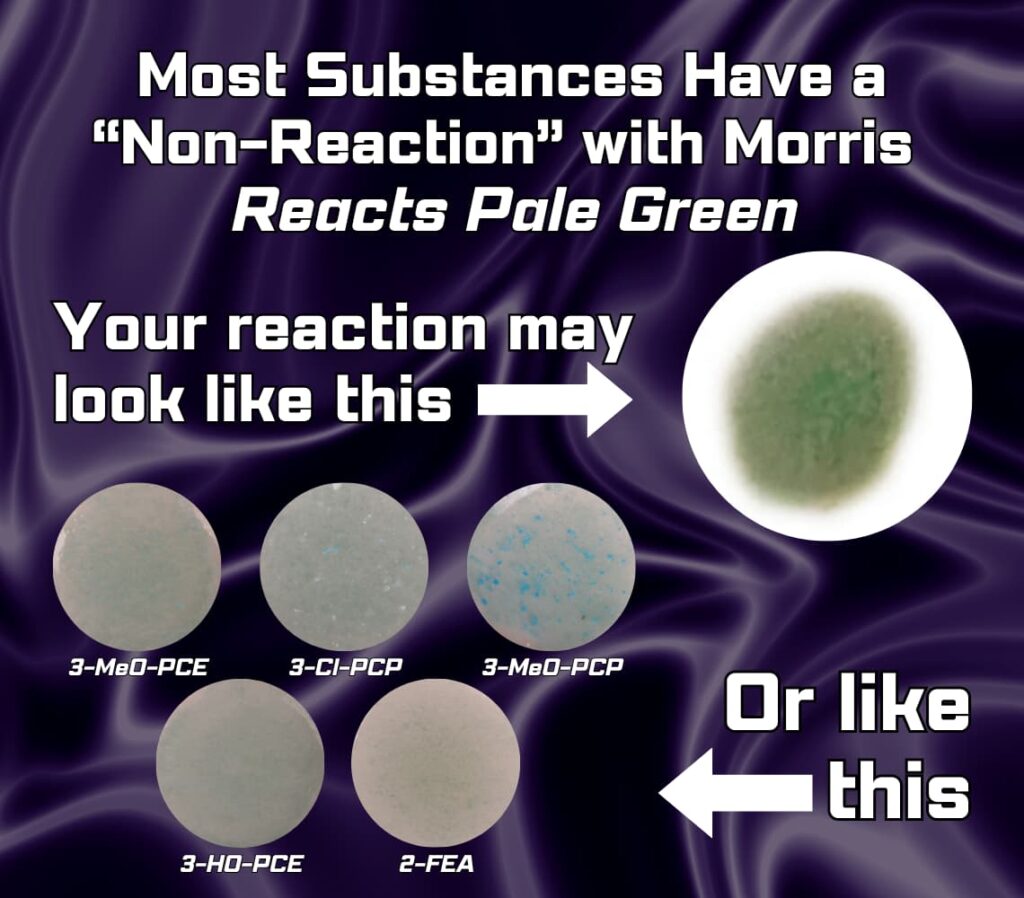
- Morris goes muddy or pale green: not ketamine, not cocaine, not DCK. A "look elsewhere" result.
- Blue-tinged results can also come from other local anesthetics, diphenhydramine, and PCP, because cobalt thiocyanate cross-reacts.
Morris reagent color guide, with dozens of reference reactions, including the ketamine violet-purple, the cocaine neon blue and the DCK navy side by side. Also included as the printed booklet in every Morris Spot Test Kit.
- Crush the sample completely. Shards and crystals give unreliable colors. Powder it.
- Measure about 5 mg, half of one of our 10 mg measuring spoons. This is the one place a rough eyeball won't do.
- Add one drop of Morris A.
- Then add one drop of Morris B.
- Stir for a full 30 seconds with a toothpick or knife tip.
- Read once the color has stopped changing. Ignore any change after 60 seconds.
Skipping the stir is the most common reason people get a weak, muddy or absent reaction. Getting the quantity wrong is the second.
Too much sample turns real ketamine navy blue. That's the same color range as DCK and 2F-DCK, so a heavy hand makes you conclude you have an analog when you have ketamine. If you get a navy, lower the sample size and run it again before you believe it. Compare with the DCK reaction video.
Synthetic cathinones give the same violet-purple as ketamine. A purple on Morris alone cannot separate ketamine from a cathinone — and cathinones are stimulants with a completely different risk profile and dose range. This is why the follow-up reagents in the package exist: ketamine reacts weakly or not at all with Liebermann, Mecke and Froehde, so a strong color on any of them alongside a Morris purple points to a cathinone rather than ketamine.
Both of these are covered in our own write-up, Testing for ketamine? Avoid these common mistakes.
- Morris does not identify individual dissociatives. It sorts results into a few buckets: violet-purple (ketamine or a cathinone), neon blue (cocaine), navy (DCK / 2F-DCK, or overloaded ketamine), muddy or pale green (most other things). It does not give a distinct, readable color for each of the dozen analogs sold as K.
- Cobalt thiocyanate cross-reacts. Other local anesthetics (lidocaine, procaine, benzocaine, tetracaine), diphenhydramine and PCP can all produce blue or blue-tinged results.
- Morris is still under study. Formulations differ between manufacturers and the reaction set is still being characterised. Treat published colors as the best current reference, not a fixed standard.
- A color is about what's most abundant. A minor adulterant in an otherwise real sample can be completely masked.
Cross-reference with more reagents
The Ketamine Spot Kit Package includes Morris, Mecke, Liebermann and Froehde, and costs less than buying the four separately.

- Morris reagent (two parts, A and B)
- The primary test for ketamine. Violet-purple at about 5 mg. Also gives violet-purple with synthetic cathinones, neon blue with cocaine and navy with DCK / 2F-DCK.
- Mecke reagent
- Exclusion reagent. Ketamine gives no strong reaction, so color here means something else is present in quantity, including dissociative analogs such as MXE, MXP, 3-MeO-PCP and 3-MeO-PCE.
- Liebermann reagent
- Exclusion reagent. Ketamine gives at most a very weak pale yellow and only with a large sample. Useful for flagging ephenidine, 2F-ketamine, N-ethyl-ketamine, MXE, 3-MeO-PCE, 3-MeO-PCP and MXP.
- Froehde reagent
- Exclusion reagent covering a similar adulterant range to Liebermann. Ketamine gives no strong reaction.
The three follow-up reagents earn their place precisely because ketamine reacts weakly or not at all with them. That's what makes a strong color meaningful — and it's the only practical way to separate a Morris purple caused by ketamine from a Morris purple caused by a synthetic cathinone.
Mecke reagent color guide, with reference reactions for the dissociative analogs commonly sold as ketamine.
Froehde reagent color guide.
Liebermann reagent color guide. Ketamine barely registers here, which is the point; read this booklet for what an adulterant looks like.
What gets sold as ketamine instead
| Substitute or adulterant | How to screen for it |
|---|---|
| Cocaine | Morris: bright neon blue instead of violet-purple. A plausible substitute and a completely different dose range |
| DCK (deschloroketamine) | Morris: navy blue. Retest with less sample to rule out overloaded ketamine |
| 2F-DCK (2-fluorodeschloroketamine) | Morris: navy blue, same caveat as DCK |
| Synthetic cathinones | Morris cannot separate these from ketamine: both give violet-purple. Follow up with Liebermann, Mecke and Froehde, where ketamine is quiet and cathinones are not |
| PCP | Morris: blue or blue-tinged via cobalt thiocyanate cross-reactivity |
| 2-Oxo-PCE, O-PCE, 3-MeO-PCE, 3-MeO-PCP, 3-Cl-PCP | Morris flags them as "not ketamine"; Mecke and Froehde for the specific hue. Compare against the booklets |
| MXE (methoxetamine) | Mecke, Liebermann and Froehde |
| MXP (methoxphenidine) | Mecke and Froehde. MXP and MXPr are different compounds, so don't treat the abbreviations as interchangeable |
| MXPr (methoxpropamine) | Morris flags it as not ketamine; cross-reference the booklets for the specific reaction |
| EPE, DPD, ephenidine | Froehde and Liebermann |
| 2F-ketamine, N-ethyl-ketamine | Froehde and Liebermann |
| Other local anesthetics (lidocaine, procaine, benzocaine, tetracaine) | No reliable reagent identification, since they cross-react with Morris. Lab analysis to confirm |
| Fentanyl | Fentanyl test strips. Reagent colors will not show it |
| Nitazenes | Nitazene test strips; fentanyl strips do not detect these |
| Inert cuts and fillers | Not detectable by color. Lab analysis if you need to know what fraction is active |
How pure is it?
The Ketamine Spot Kit Package tells you what's likely present, not how much of it there is. Reagent color is driven by whatever is most abundant, so a heavily cut sample and a clean one can look the same. If you need an actual concentration figure, that's lab analysis — Transparency Testing, our mail-in lab, will quantify what a color cannot using FTIR and LC-MS.
Step by step
- Test for opioids first. Roughly 10 mg in half a teaspoon of water, fentanyl strip and nitazene strip, read at five minutes. Test more than one spot from a larger amount.
- Crush thoroughly. Morris needs powder, not shards.
- Measure about 5 mg, half a 10 mg measuring spoon.
- Run Morris. One drop A, one drop B, stir a full 30 seconds, read when the color settles and ignore anything after 60 seconds. Violet-purple is consistent with ketamine.
- If you got navy, retest with less. Overloading turns ketamine navy and imitates DCK.
- If you got nothing, retest with more. Below roughly 5 mg Morris simply won't react.
- Cross-reference on fresh samples with Liebermann, Mecke and Froehde. Ketamine should be quiet on all three. Strong color means something else is in there, a cathinone included.
- Record it. Photograph your results in good light next to the booklet, and send unresolved samples to Transparency Testing for a definitive answer.
- Not stirring Morris for the full 30 seconds. This is the single most common mistake.
- Too much sample: real ketamine reads navy and you conclude DCK.
- Too little sample: 1–2 mg gives no reaction at all, which looks like a negative.
- Samples that aren't fully crushed.
- Reading Morris after 60 seconds. Late drift is not part of the result.
- Dim or colored lighting. Bright neutral daylight, and compare against the printed booklet.
- Running two reagents on the same sample, or reusing a tube. Use a fresh portion for each.
- Old reagent. It degrades; store it cool and dark, and replace it annually.
- Reading only Morris. A violet-purple on its own cannot separate ketamine from a synthetic cathinone.
Your result wasn't what you expected
- Rule out the test itself first. With Morris this is unusually important: retest with a smaller sample if you got navy, a larger one if you got nothing, fresh reagent, a full 30-second stir, and bright daylight. A lot of "wrong" Morris results are sample-size errors.
- Find out what it actually is. Mail a sample to Transparency Testing, our mail-in lab analysis service — a definitive answer where reagents can't give one, including the cathinone-versus-ketamine question and the specific analog.
- If an opioid is plausible, have naloxone in the room. Powder sold as K can be contaminated or substituted. Never use alone. Ketamine's own sedation makes an unrecognised opioid harder to spot in someone.
- A neon blue means stop. If Morris goes bright blue you are most likely looking at cocaine, which is dosed nothing like ketamine.
Questions
Does a Morris purple confirm ketamine?
No, and we've stopped implying that it does. Morris is the primary test for ketamine and a violet-purple result is consistent with it, but synthetic cathinones give the same color, and cobalt thiocyanate also responds to other local anesthetics, diphenhydramine and PCP. Morris narrows the field without naming the molecule, and only lab analysis does that.
My sample turned navy. Is it DCK?
Maybe, or you used too much. Overloading Morris turns real ketamine navy blue, which sits in the same range as DCK and 2F-DCK. Halve your sample and run it again before you conclude anything. This is a documented false negative.
Nothing happened at all. Is it fake?
Unknown. Morris won't react to 1–2 mg of ketamine. Increase to about 5 mg, make sure it's fully crushed, stir the full 30 seconds, and check that your reagent isn't over a year old. A non-reaction is an unresolved test, not a negative.
How do I tell ketamine from a synthetic cathinone?
Not with Morris alone — both give violet-purple. The practical approach is the rest of the package: ketamine reacts weakly or not at all with Liebermann, Mecke and Froehde, so a strong color on those alongside a Morris purple points away from ketamine. If it matters, lab analysis through Transparency Testing is the reliable answer.
Does Liebermann identify ketamine?
No. We used to say it did. Liebermann gives at most a very weak pale yellow with ketamine and needs a large sample to give even that. It's an exclusion reagent, and its value is flagging adulterants that react strongly where ketamine doesn't.
Can I test liquid ketamine?
Testing in solution changes the reactions: Marquis and Mandelin go quiet, and Mecke picks up a yellow-orange from the liquid itself. Compare against the solution reaction set above, or better, let a few drops dry and test the residue as powder.
Do I need fentanyl strips for ketamine?
Yes, we'd use them. Ketamine powder isn't exempt from opioid contamination, and most people using it have no opioid tolerance. Add nitazene strips as well, since fentanyl strips don't detect nitazenes.
How much do I need to test?
Morris wants about 5 mg, which is half of a 10 mg measuring spoon. The other reagents are less fussy; a few milligrams is fine. Strips need roughly 10 mg in about half a teaspoon of water.
Does a good test mean my ketamine is safe?
No. Reagent results are presumptive, they only describe the portion you tested, and they show what's most abundant rather than everything present. Testing lowers your chance of an unpleasant surprise; it doesn't remove risk.
Ready to test?
Serious drug checking at home. Orders ship within 24 hours.
Morris, Mecke, Liebermann and Froehde · Discreet packaging
More resources
- Testing for ketamine? Avoid these common mistakes: the sample-size problem in detail
- Ketamine reaction video showcase: every reaction above, in full
- Morris reaction booklet
- Our types of test kits
- Skylab separation kit basics: for mixed samples
- How to test cocaine: the other side of the Morris blue/purple confusion
- How to test for nitazenes: why fentanyl strips aren't enough
- Reaction video library: watch colors develop in real time
- Spectrum color guide
- Lab testing with Transparency Testing: for the questions reagents can't answer
A sample that has been tested should not be considered safe. There is inherent risk when choosing to consume any substance.
Many factors are involved when conducting a test and examining reactions, and The Bunk Police does not assume responsibility for the interpretation of results. Reactions of individual samples can vary depending on lighting differences and the specific mixtures of substances being tested.
Bunk Police kits are intended for identifying unknown substances for harm reduction purposes only. The Bunk Police does not assume responsibility for the use or misuse of this information. Proceed at your own risk.